Category Archives: Game Reviews

Final Fantasy (NES) Review (1987)

Hey all it’s Kern here! I’m coming at you with a game review of Final Fantasy. Yep… we need to go back to where it all started. These days the game is kind of messy and doesn’t hold up the way slightly later titles do, but let’s not judge it too harshly… it did after all save Square Soft’s butt back in the day… lol.

These days, we know them as Square Enix, but back then, they were just a tiny, assumed to be doomed company.

Before we begin, this game has had a lot of ports, but this article here is a pretty staunch defender of the classic title, and it’s worth a read if you want to know about the more modern port of the game.

A Franchise Born on the NES

Final Fantasy is a 1987 fantasy role‑playing game developed by Square for the NES. At the time, Square was practically bankrupt and this game was their last ditch resort. Needless to say, the game was a hit and it saved the company. It also launched what would become one of the best‑selling video game franchises in history… but that’s another story… one we will get to as I review this franchise in earnest.

Now, I’ve played a lot of Final Fantasy games over the years, and my first Final Fantasy game ever was Final Fantasy VI (or FFIII for the NES). I was much older when I played the original game. When I fired up the NES original, I didn’t have high hopes. I mean, the game came out all the way back in 1987. It was all pixels and a prayer. There were absolutely no CGI cutscenes, no espers or materia, and no iconic characters as we know them today…

Beyond that, jobs and abilities were hugely limited. There was only a White Mage, Black Mage, Red Mage, Thief, Warrior and a Black Belt to choose from when you begin the game, although these jobs change to what FFXI and FFXIV would know of as advanced jobs as you play through the original Final Fantasy.

That being said, since this game set the baseline you can see a lot of the standard Final Fantasy DNA here, along with other role-playing games of the era. Anyway, I fully expected it to feel clunky, flat, and a bit painful… and to be fair, it is…. it’s the very first game, after all.

So, I find that being the first game in such a long running and beloved franchise forgives a great deal, and it excuses Final Fantasy too due to age.

Hey, it’s not like I didn’t have my biases against the game, either. For example, without buying gear or magic, you’ll die almost instantly in the over world. Now, most FF games assume you might do that, and gives you a very basic set of gear to begin with unless you happen to be a very special breed of clunky (Final Fantasy XI, looking at you my beloved MMO diamond in the rough… but, seriously, WTF?!)

I digress… anyway, at least there was one thing players had to help them out a fair bit. Fun fact, did you know the original Final Fantasy came with a beautiful full-color, 89-page manual? It didn’t come with just basic instructions, this thing had it all. I’m talking full on mechanics here; total spell breakdowns, beautiful maps, and all of it decently laid out. The book even included a fairly decent walk-through for most of the game.

Seriously, if you’re going to play the original Final Fantasy, or any of its iterations/remasters, then use that book or an online guide to help out a little. Although, maybe I’m partial to it, there’s just something about sitting in front of a guide, feeling the pages between your fingertips, with a controller in your lap, you know?

I did that with a lot of games growing up, and it’s how I learned to read, actually. I didn’t always write book reports, I wrote full on “game reports” since there’s more reading in one of those games than an average children’s book I got away with it too, lol…

In any case, let’s really talk about just how ambitious this game really is. It is a bit clunky without the guide, I must admit, but let’s chat about what they got right, and horrifically wrong.

The Good, The Bad, the WTF!

First of all, this game is all the standard Final Fantasy joys reduced down to their most simple components… we’re talking towns, dungeons, vehicles, and elemental temples, job classes, and other retro rpg set pieces.

You build your own team in the first game. Four characters, six jobs to choose from, and your choices actually matter a lot.

To rehash, the jobs are: Fighter, Thief, Black Belt, White Mage, Black Mage, Red Mage.

Pick wrong, and the game punishes you. Pick right, and it rewards you with just enough flexibility to survive the punishing grind… and yeah, say it with me now…

“Level grind, level grind, makes you lose your freakin’ mind!”

Yeah, the grind is the real deal. This is an old-school RPG, you’re going to be grinding a lot. You need it for your cold hard cash (Gold in this case it wouldn’t be called Gil until later), leveling up, and even just to get from place-to-place enemy encounters can happen a lot. I’ve personally always felt that a sense of slow growth is so satisfying, but here it does feel like a little bit too much.

It’s a slog really…

These characters don’t really have firm personalities, it doesn’t feel as rewarding to level them up. We just don’t have a Sabin Figaro or Cloud Strife to bank on here.

Still, in a general sense at least, every step forward feels earned. Every spell slot, every upgrade, every boss victory… yeah, sure, it fits just fine and dandy. To some degree, it felt like it mattered “enough”, which for the first game ever from a failing company in bankruptcy says a lot.

Without fully fleshed out characters though, the story is downright bare-bones.

You’re the Warriors of Light, just without the bombastic plot of FFXIV. Of course, there are monsters and a big baddie in your way. This screen here basically tells you all you need to know about the over all plot:

Erm, yeah… that’s about it.

I know, I know, I just described most RPGs of the era, and of course I did… that was the standard formula back in the day, more or less. Honestly, I can’t fault it too badly. The simplicity actually works, and not everyone is like me, demanding heavy and thoughtful plots in their games.

Final Fantasy doesn’t care if it’s got a rich story, it isn’t pretending to be deep. It won’t pull off philosophical themes or cinematic twists. In that way, it may just be the perfect Final Fantasy game for some players.

Where the game really does well is within the overall mechanics and gameplay loop. Although, the game can be hard for those that don’t play rpgs. There are five different ways to travel: walking, canoe, boat, airship, and even teleportation. Without a story, that’s part of why it’s so easy to get lost…

The dungeons are punishing too. Some of them are just straight-up downright brutal and will wipe the floor with you if you go in unprepared. Stock up, seriously…

Stock up!

You’re going to hit battles with preemptive strikes, and some of those hit way harder than you’d think they would. There are no Phoenix Downs in this version (another downside), so if someone dies, your only option is to hike your happy ass all the way back to town and pay to revive them… not a fun thing to do, really.

If half your party gets wrecked halfway through a dungeon, that’s it! You’re kissing your butt goodbye on a game over… either that, or you’re pulling a clinch-kill in that final half with pure luck and gumption alone.

Let’s not pretend the game doesn’t have massive flaws where it counts too. Because it absolutely does. A lot of them. Stats like Intelligence? Erm, they kinda don’t really work… like, at all. As for spells like TMPR and SABR? Those are a real fart in the wind… and it only gets worse from there when it comes down to issues.

Overall, when you’re talking about general Crit rates, those are supposedly tied to weapon position in the data table, which means cheap early weapons are sometimes the absolute best.

Also, basic potions suck hardcore… so there’s that. Enemies can stack large numbers during an encounter (hence the grinding, alllll the grinding).

Then, of course, we have the little spell related issues. Spell slots are so limited, you’ll be rationing magic in ways that can be annoying just on principle… but, that’s the nature of the game and a product of its time.

The problems aside though, combat is pretty basic but a lot of turn based systems are… not much to say about it really. If you’re a fan of old school RPG’s you know roughly what you’re in for.

So… Is It Worth Playing?

Yeah… yeah it is… more or less…

Look, it’s a clunky old fart, to be sure… but, it’s an old fart of a game that deserves recognition, and I’ll give it that.

Final Fantasy on the NES is a rough game to play for some people, but it’s rough in that lovable, if amazingly groundbreaking way that early gaming classics are.

Yes, it does often miss the mark… but think of it more like a beta for what Final Fantasy as a franchise would one day become.

Personally, I can feel the ambition behind every mechanic. I can see what the devs were trying to do, even when game failed to fully accomplish it. failed to do it… and to me, that makes it a special little gem worth playing.

Despite the bugs, the balance issues, the grind, hardly any decent characterization, and even less in the way of guidance, not to mention the glitches, this game is an achievement onto itself.

No matter what we might think about it, Final Fantasy put Square Soft (now Square Enix) into the long lived gaming studio we know and love it to be… even when they still succumb to janky ideas that needed more time to cook (Thank you Dawn Trail).

I was pretty harsh on this game though, so let me put a little balm on the wounds I just sliced into it by leaving a fan song here:

This has been Kern of The Demented Ferrets, where stupidity is at its finest and level grinds are par for the course. I’ll see you next time! For now, check out some other stuff below and don’t forget to support us on Patreon! We’ve got a $1 tier, and every little bit helps!

YouTube Playlists of Interest:

FAIL: Fallen Angels in Limelight – rock, glam rock, hard rock.
City of Shadows Album 1 – A musical story about two cities joining together as one deep in the desert. A literal tyrant has come to lay claim to the city, and an uprising occurs.
City of Shadows Album 2 – The exciting continuation of City of Shadows. Time to set out and travel the world! This story is ongoing, with song releases every Wednesday and Friday.
Roll for Glory Album – An album dedicated to the wonderful world of DnD, and the fictional band in “Thunderous Power Kicks” (T.P.K) led by their fearless leader and Bard.
RWBY Fan Songs – Fan made songs for the RWBY series encompassing several musical styles. (Kern’s on going project).
Video Game Fan Songs – Fan made songs about video games spanning a wide variety of gaming genres and song styles (Kresh and Kern’s ongoing project).
Ferret’s Synthwave – Songs with a Synthwave vibe.

Final Fantasy (NES) Review (1987)

I’m coming at you with a game review of Final Fantasy. Yep! We need to go back to where it all started. These days the game is kind of messy and doesn’t hold up the way slightly later titles do, but let’s not judge it too harshly… it did after all save Square Soft’s butt…

Loot River Review

For starters, Loot River is an action based rogue-like game that was developed by STRAKA.STUDIO. It was also published by STRAKA.STUDIO and SUPERHOT PRESENTS. This game was announced back in 2021 and released on Steam for Microsoft Windows on May 3, 2022. What you’ll get here is a fusion of puzzle solving and action based gameplay.…

Should I get into Elite: Dangerous in 2022? Yes! Here is why…

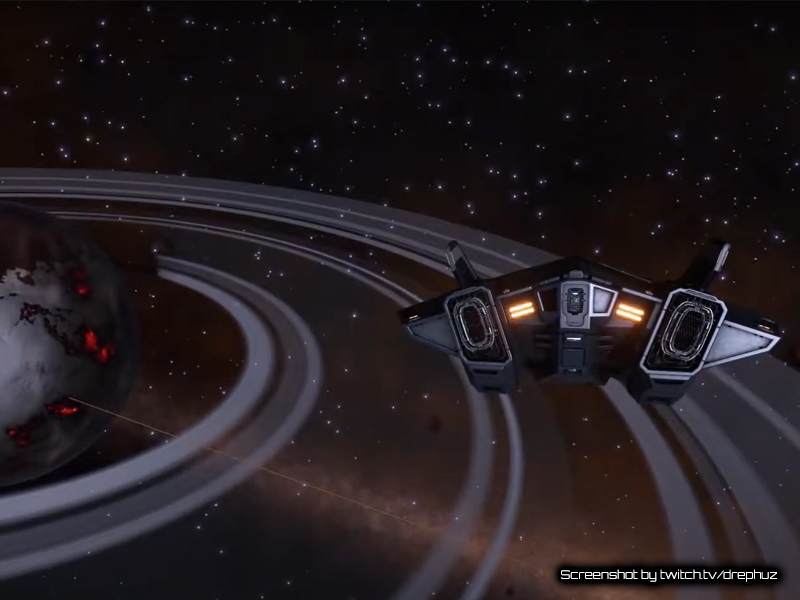
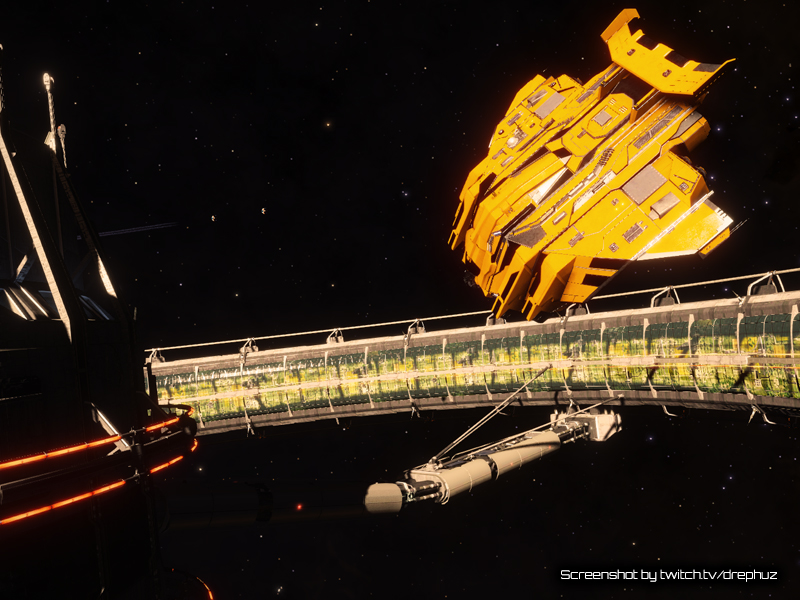
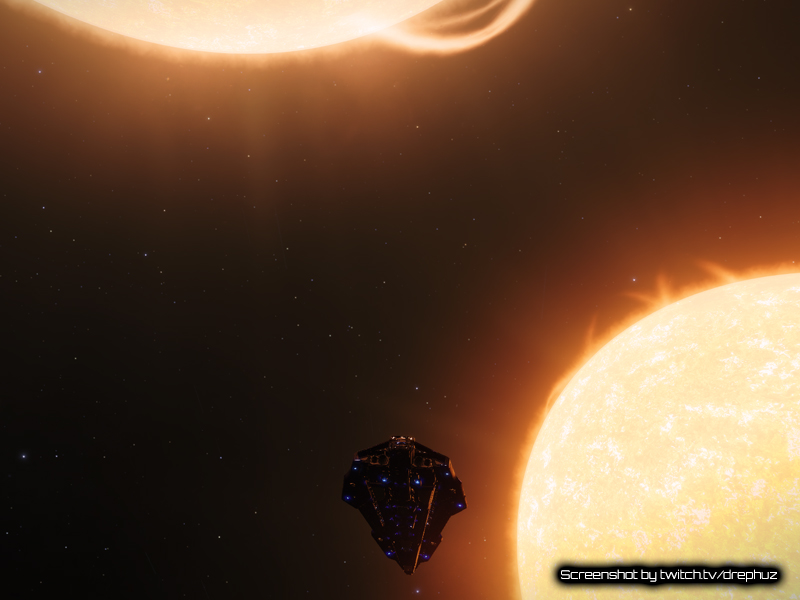
Elite: Dangerous is the modern installment in a series of renown space simulation games from Frontier Developments. If you have ever wanted to experience what it would be like to make a living hopping from star to star in the Milky Way galaxy, this is the game for you.

Top 5 Bosses from The Legend of Zelda: Ocarina of Time

Hello everyone, this is Ebby of The Demented Ferrets. This will be a Top 5 list of my personal favorite Bosses from The Legend of Zelda: Ocarina of Time for the Nintendo 64. Please note that these are simply my opinions, and I do not speak for anyone else.

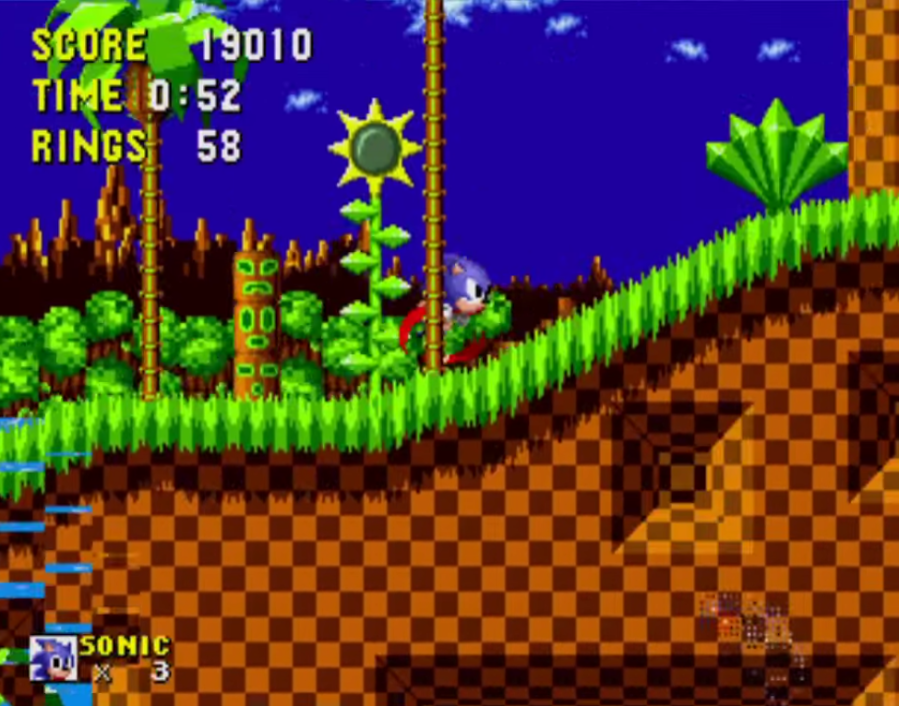
Sonic the Hedgehog (SEGA Genesis) – A 16-Bit Icon That Redefined Speed

Release Date: June 23, 1991
Developer: Sonic Team
Publisher: SEGA
Platform: SEGA Genesis / Mega Drive
Genre: Retro Platformer

Hey all, it’s Kern here, and we’re blasting to the past “faster than the speed of light”. Yep, you see what I did there, I’m sure. In 1991, Sonic the Hedgehog burst onto the SEGA Genesis with a streak of blue and a cocky smirk, instantly becoming the face of SEGA’s brand, much like Mario became Nintendo’s. The game isn’t just another mascot platformer. Nah, I became a full-blown cultural phenomenon that brought a new level of speed, style, and difficulty to the genre.

Over three decades later, does this Genesis classic still hold up? Well, let’s figure that out.

The Gameplay – Fast, Fun, and Fluid

At its core, Sonic the Hedgehog is a side-scrolling platformer, but it has a few key things to consider. The game is ultimately all about momentum-based physics and high-speed traversal. Unlike Mario’s precision style hopping across the levels, Sonic thrives on the ebb and flow of each stage. It’s all about maintaining speed and reacting in real time to a world built for blazing-fast movement.

You play as Sonic, a blue hedgehog with “cool” attitude, on a mission to put a foot up Dr. Robotnik’s behind (later he should be known as Eggman). He’s been turning the woodland creatures into machines, and you’ve got to stop him. Simple premise, brilliant execution.

Quick Gameplay Highlights:

  • Speed-focused level design with multiple routes.
  • Tight, responsive controls, no spin dash, though. Spin dash wasn’t added until later games.
  • Rings are your life gauge! So long as you’ve got a ring on you, you can get hit. As long as you don’t fall down a hole, or drown, you’ll be okay so long as you have a ring.
  • Collect 100 rings, when you do, you get an extra life. Remember, when you take one hit without rings, that’s game over.
  • Bonus stages, they show up, and they’re pretty fun.

The Visuals – Bold and Beautiful

Each zone has its own aesthetic identity, from the lush greenery and waterfalls of Green Hill Zone, to the gritty gears of Scrap Brain, and stone brick in Marble Zone. For its time, bright flashy colors were the way platformers looked. In an attempt to appeal to children, that was fairly common. That being said, SEGA’s art direction for Sonic the Hedgehog was revolutionary for the early ’90s. The Genesis had a color palette that was able to showcase the completely vibrant backgrounds, and it looks gorgeous considering the speed at which Sonic runs through the game. It would have been so easy for the game to look like a muddy blur, but it never does.

Music & Sound – A Timeless Soundtrack

I think it goes without saying that some games leave ear worms behind. Just as classic Mario games have an iconic soundtrack, so does Sonic. Composed by Masato Nakamura, the soundtrack is a a true masterclass in 16-bit music design. Each zone’s theme is memorable and perfectly suited to its tone and visuals. Even decades later, tracks like Green Hill Zone and Starlight Zone remain etched in the minds of gamers everywhere… honorable mention to the boss fight theme, and the title screen. They’re just so memorable to me.

Difficulty – It’s Hard!

Okay, okay maybe not as hard as some platformers of today. For its time though, this wasn’t a super easy game. The game eases players in, giving you somewhat forgiving early stages. The thing is, it ramps up sharply. Once you hit levels like Labyrinth Zone, you’ll be in trouble. It is a water level… so have fun. Like all water levels in retro Sonic games, it has some pretty unforgiving water physics. Boss fights against Dr. Robotnik (Eggman) are fun but not hard to figure out. The Stages themselves are where the difficulty is really at. At least in the boss fights, if you’ve got a ring on you, you’ll be okay.

While not unfair, the game doesn’t always think through its gameplay style. The game demands memorization of each stage if you want to play them completely fluidly. Even then, you’ll need patience in later stages, and in a game about speed slowing down in a real pain in the butt sometimes.

Legacy – A Game That Changed Everything

Sonic the Hedgehog wasn’t just a game—it was a movement. Sonic made the Sega Genesis a household name to so many of us. It gave SEGA a foothold in ’90s console wars, and a worthy rival of Nintendo. Obviously, the game is part of our culture as gamers too. The franchise has only grown, and continues to do so. These days, Sonic fans have a literal empire of sequels, cartoons, comics, and films to enjoy

My Few Criticisms

So, as I said above, the first game has No spin dash to speak of. If you’re used to playing other games, you can’t expect to have it in this one. The pacing issues I described, you do have to slow down sometimes (looking at you, Marble and Labyrinth zones). For it’s time, Bosses are what you’d expect. That means they’re also standard. A lack of variety in fighting them comes down to recycling simple attack patterns, and hitting the boss at the right time… the first iteration of the game didn’t have a save system, and that’s something to keep in mind. Later remakes and later games would have one.

Final Verdict – A 16-Bit Classic, Play It

Sonic the Hedgehog for SEGA Genesis isn’t just a platformer, it’s a game design landmark and fandom touchstone. Even without the refinements of its sequels, the original remains wildly fun, stylistically sharp, and culturally significant to gamers everywhere. Whether you’re a retro fan revisiting your childhood or a new player exploring gaming history, this is a must-play title.

Some Fandom:

As I do love the sonic franchise, I made a few fan songs for the game, and they were a lot of fun to make. you can find them both here:

This has been Kern, of The Demented Ferrets, where stupidity is at its finest, and level grinds are par for the course. I hope you liked the songs and enjoyed the review. Don’t forget to follow us over on YouTube for all kinds of fan songs and other content. We’ve got a Twitch, we play games there, so if that’s your jam come say hello when we’re live. As always, you can support us over on Patreon if you like what we do! Please check it out and consider joining.

That’s all for now, I’ll catch you next time!

Have you replayed Sonic recently? Share your favorite zone, in the comments below!


YouTube Playlists of Interest:

FAIL: Fallen Angels in Limelight – rock, glam rock, hard rock.
City of Shadows Album 1 – A musical story about two cities joining together as one deep in the desert. A literal tyrant has come to lay claim to the city, and an uprising occurs.
Roll for Glory Album – An album dedicated to the wonderful world of DnD, and the fictional band in “Thunderous Power Kicks” (T.P.K) led by their fearless leader and Bard.
RWBY Fan Songs – Fan made songs for the RWBY series encompassing several musical styles. (Kern’s on going project).
Video Game Fan Songs – Fan made songs about video games spanning a wide variety of gaming genres and song styles (Kresh and Kern’s ongoing project).
Ferret’s Synthwave – Songs with a Synthwave vibe.

Survival, Terror, and the North Sea: Still Wakes the Deep (Quick Review)!

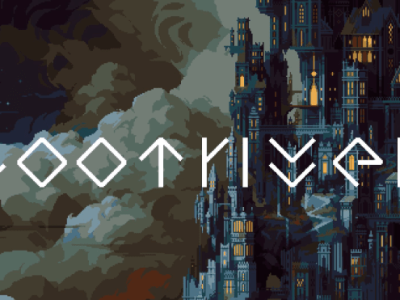
Hey everyone, It’s Kern here…. you know, last year was packed with standout horror titles, and I didn’t really get around to reviewing them the way I hoped for. It’s time I got around to it now; Still Wakes the Deep makes a haunting impression with its claustrophobic tension, atmospheric design, and a chilling dive into psychological horror. This thing won a lot of awards too, which you can see for yourself:
The game was developed by The Chinese Room, the same studio behind narrative-driven games (walking simulators as some call them), like Everybody’s Gone to the Rapture and Dear Esther. Because they’re easy to play, they’re very accessible for novice gamers looking for a good story. You can find both of those games on Steam. For those of us who want some heavier gameplay, though Still Wakes the Deep is a solid choice.

As far as Still Wakes the Deep is concerned, the game is a slow-burning nightmare set against the brutal backdrop of the North Sea in the 1970s. You play as Cameron “Caz” McLeary, who happens to be an electrician working aboard a massive oil drilling platform. After everything goes right to hell in a handbag (as things tend to in horror games), the rig is damaged and everything rapidly descends into chaos. To make matters worse, monstrous entities begin to appear, stalking the creaking metal corridors. So, yeah, you’re screwed!

There’s no way off the rig, no help coming, and nowhere to hide for long. So what do you do? Run, hide, and keep away from the big baddies, that’s what! Still Wakes the Deep foregoes combat entirely. It’s all about survival. You spend time sneaking past unseen horrors, solving environmental puzzles, and navigating the collapsing rig under relentless storms. The first-person perspective heightens the immersion, placing you firmly in the hot seat as Caz, come hell and high water. That’s right, you get both! If you don’t like deep water horror, this is NOT the game for you.

For fans of story-driven horror set on open water and oil rigs, Still Wakes the Deep is a must-play experience. It’s not about cheap jump scares…. nah, instead, it delivers a slow, dread-filled experience that lingers long after the credits roll.

Kresh even made a fan song about it, so take a listen, if you want to! Just keep in mind, spoilers are layered within the song, obviously!

Well, that’s all for now everyone. This has been Kern of The Demented Ferrets, where stupidity is at its finest and level grinds are par for the course.

Loot River Review

Hey guys, it’s time for another review, this time I’m taking a look at Loot River. Coined as a “Souls-like” game with Tetris elements this is one interesting little game.

For starters, Loot River is an action based rogue-like game that was developed by STRAKA.STUDIO. It was also published by STRAKA.STUDIO and SUPERHOT PRESENTS. This game was announced back in 2021 and released on Steam for Microsoft Windows on May 3, 2022.

What you’ll get here is a fusion of puzzle solving and action based gameplay. Loot River kicked me in the behind more than not, and the reason for this is because I found the game to be fairly difficult. The iteration isn’t too bad when you die, thankfully, because whenever you die you’re booted back to the back to square one. If you die, then you’ll have to start all over at the first level. Your desperately collected upgrades will be lost.

The atmosphere casts dark shades and tones throughout the level design. It’s a little gritty, although charming. Generally speaking, the Tetris style comes into play because you have to move the level around to travel through it.

The dark and gritty tones begin literally upon the onset. You’ll play through sections of hovel filled with bloodied discarded waste and what looks to be the remnants of a disaster.

You’ll have to figure your way around these platforms with dark shadowy monsters and this is probably my one gripe about the pixel style art design. Although the world and gameplay flows well and certainly feels dynamic, it can also be difficult to discern what something is.

One might say this adds to the horror tropes just a little. One might also say that the style needs to be this way, and I’d actually agree with that. Loot River has levels that are procedurally generated, so the block-sliding puzzles and deep labyrinth that you traverse are never quite the same way twice.

Occasionally, you’ll come across tiered platforms and traps that almost remind me of Resident Evil when it comes to recalling your best escape route. the moment things go down-hill… and I promise you this; sooner or later things will go down hill. Surprise enemies with ranged abilities will knock your block off, and each moment the screen pans, you should be thinking ahead. It’ll keep you on your toes, I’ll say that much.

Honestly, I wish that I could say that the unusual movement mechanics provided for the gameplay pairs nicely with the combat, but I personally don’t think it does. Maybe it works better for those with quicker reflexes. You can use magic spells to go temporarily invisible, and I’m sure you can dart away from opponents if you’re fast enough. I’m often not fast enough, though.

Personally, I often ended up trying to parry and pray that it worked. Yeah, that’s where the majority of my deaths happened, I won’t lie. Trying to get the timing right takes a bit of learning for sure. Either way, at least it feels good to land a solid blow to your attacker.

Loot River to me isn’t as “souls-like” as so many people make nods to. Yeah, it’s hard, sure… but a lot of rogue-like games are hard. That’s kind of the nature of the game style. Clearly, Loot River has a strong foundation in the rouge-like genre. To me that’s where the comparison fits. That’s the best thing about it, you can play it endlessly and you’ll need to if you want to uncover everything.

Unlocking the upgrades, figuring out the tiny secrets, and piecing together the deeper lore of the story takes time. You’re not going to have it all figured out on the first play through, assuming you even survive that long, which I doubt.

The game isn’t perfect, but it is a lot of fun. You’ll be hard pressed to put it down. Die enough to cheap shots like I did, and you’ll be irritated too, I’m sure. That’s honestly why so many people make references to Loot River being a “souls-like” game.

Rating: 3 out of 5.

I’m going to give it a solid three out of five stars. It’s middle of the road, but it does interesting things. I can’t deny it. Loot River gives a breath of fresh air to the pixel style of the rouge-like genre. If that sounds interesting enough for you then give it a try and see for yourself.

This has been Kernook of The Demented Ferrets, where stupidity is at its finest and level grinds are par for the course. I’ll see you next time.

With your contributions, you make our efforts possible. Thank you for supporting our content. Patreon supporters receive access into our official Discord server, and a few other perks depending on the tier. If you don’t care for Patreon, and don’t care about perks, you can always support us through PayPal too… links below.

Those who join via Patreon get special perks, such as extra content, quicker updates, and more.

Click to Donate

To Our Supporters

Thank you for helping us to enrich our content.

Patreon Supporters:
($3) Little Ferrets: None
($5) Demented Minions: Andrew Wheal.
($7) Fandom Ferret: None
($14) True Blue Ferret: Francis Murphy and Bryan BSB.
($25) Premium Ferret: None.
($50) Round Table Ferret/Fluffy Ferret: Josh Sayer

Meanwhile, check out some of our other great content.

Should I get into Elite: Dangerous in 2022? Yes! Here is why…

Elite: Dangerous is the modern installment in a series of renown space simulation games from Frontier Developments. If you have ever wanted to experience what it would be like to make a living hopping from star to star in the Milky Way galaxy, this is the game for you.
E:D gives you the opportunity to take on many different roles as a space commander, including bounty hunting, trading, mining, exploration, and even xeno-hunting (aliens). Many space enthusiasts alike have flocked to the E:D universe over the years to find their place among the stars.

With Frontier Developments’ latest expansion to the E:D universe, Odyssey, commanders have been given the wonderous opportunity to hop out of their ship at any space port or landable planet and explore on foot!  While this expansion has received mixed reviews, it has opened an amazing experience including exobiology, ground combat, and space port exploration.

Commanders in Elite: Dangerous can participate in several different combat environments depending on what kind of trouble they put themselves into.  Earlier on, one may find themselves scanning for criminals, picking off pirates and bounties near the navigation beacon of a nearby star.  Experienced combat veterans will often find themselves participating in conflict zones to help turn the tides of battle for the faction of their choice. Finally, the bravest and most talented of these commanders can choose to go against the threat of the alleged alien menace, the Thargoids.

As a Trader in the E:D universe, you can go about making credits in a variety of ways.  A commander can take a contract from a nearby spaceport and simply deliver some goods from one star system to the other. Sometimes those goods may not be legal in the destination system, requiring the commander to avoid being scanned upon arrival.  Commanders may also take advantage of buying and selling commodities from space ports at a profit using the in-game economy system for supply and demand. Finally, if you want some real action in the trade aspect of E:D, you might be interested in getting into mining.  Not only can trade commanders make credits mining the surfaces of asteroids, but some of these hunks of rock can be strategically detonated for high priced commodities during core mining operations.

What’s the best part about a space simulation game? Exploring the stars, of course! With over 400-billion star systems generated in the Elite: Dangerous’ Milky Way galaxy, there are hundreds of different types of environments, and practically infinite different configurations of solar systems that can be discovered by each commander in the E:D universe. First time discoveries are recorded and shared with all other commanders in the galaxy, and with only an astonishing 0.05% of the simulated galaxy discovered at the beginning of 2022, there is no doubt that any commander can find themselves a place to put their name among the stars.

Finally, the Elite: Dangerous universe includes what is called the “Background Simulation” (BGS).  All player activity as commanders affects the BGS in a sense where the community, or sometimes even a single commander, can shape the fate of a single star system or cluster.  Community Events are announced often regarding major events in the E:D universe, and things have recently gotten very interesting… why not take a look?

This has been a blurb by Drephuz of the Demented Ferrets, a Twitch streamer, a drone pilot, and an all around tech nerd. You can catch him on Twitch playing games and mostly being inappropriate. Stop on by!

Like anime, gaming, movie reviews and more? What about RWBY Analysis? If so, check out our other platforms and support our content. Also, please don’t forget to follow our blog for more content like this.

Click to Donate

You can help support us through PayPal or Patreon. You can support us for as little as $1 a month.

Patreon Supporters:
($1) General Ferret: None
($3) Little Ferrets: Emily Turner
($5) Demented Minions: Andrew Wheal.
($7) Fandom Ferret: None
($14) True Blue Ferret: Francis Murphy and Bryan BSB.
($25) Premium Ferret: None.
($50) Round Table Ferret/Fluffy Ferret: Josh Sayer

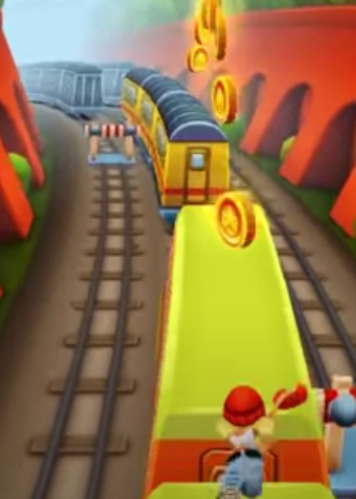
Subway Surfers Review

Hey everyone, it’s Kernook here and today we’re going to be discussing Subway Surfers, which happens to be an “endless runner” sort of mobile game. I typically don’t discuss games in the mobile market, but every now and then I do like to dip my toes into it… all in all, it is a pretty fun game too.

This brightly colored, generally kid-friendly game was co-developed by Kiloo and SYBO Games. These are private companies based out of Denmark. The game is available on Android, iOS, Kindle, and Windows Phone app providers, and it uses the Unity game engine. The game was released on May 25th of 2012.

As an “endless runner” the game is exactly what it sounds like for the genre. You run endlessly collecting items and avoiding obstacles. The perpetual movement adds a layer of challenge as the game ramps up. The difficulty curve is fair enough, I suppose. It isn’t too difficult, it is aimed at kids after all. You’ll gather coins, and try to avoid the subway policeman. He’s got a dog too, and that can be a pain in the butt.

Generally speaking, the trains, construction barriers and train platforms are the main things that get in your way. You’ll have to dodge around them, or have an item that allows you to traverse the level. There’s a little bit of platforming involved, too.

Loading times are a bit on the slow end. Given the graphics, I can’t say I’m surprised. It is an older title, and you can certainly tell that as well. I’d say it’s a good game to play for a “short time waster” whenever you happen to be bored for a short amount of time. Since the game is free and it is a mobile game of all things, expect advertisements galore.

Subway Surfers has aged a bit these days, but it still holds up well enough, I suppose. It still looks great, it feels great, and clearly holds a decent ranking in the endless runner game category.

YouTube Playlists of Interest:

City of Shadows Album 1 – A musical story about two cities joining together as one deep in the desert. A literal tyrant has come to lay claim to the city, and an uprising occurs.
Roll for Glory Album – An album dedicated to the wonderful world of DnD, and the fictional band in “Thunderous Power Kicks” (T.P.K) led by their fearless leader and Bard.
RWBY Fan Songs – Fan made songs for the RWBY series encompassing several musical styles. (Kern’s on going project).
Video Game Fan Songs – Fan made songs about video games spanning a wide variety of gaming genres and song styles (Kresh and Kern’s ongoing project).
Ferret’s Synthwave – Songs with a Synthwave vibe.

This has been Kernook of The Demented Ferrets, where stupidity is at its finest and level grinds are par for the course. I’ll see you next time.

With your contributions, you make our efforts possible. Thank you for supporting our content. Patreon supporters receive access into our official Discord server, and a few other perks depending on the tier. If you don’t care for Patreon, and don’t care about perks, you can always support us through PayPal too… links below.

Those who join via Patreon get special perks, such as extra content, quicker updates, and more.

Click to Donate

To Our Supporters

Thank you for helping us to enrich our content.

Patreon Supporters:
($3) Little Ferrets: None
($5) Demented Minions: Andrew Wheal.
($7) Fandom Ferret: None
($14) True Blue Ferret: Francis Murphy and Bryan BSB.
($25) Premium Ferret: None.
($50) Round Table Ferret/Fluffy Ferret: Josh Sayer

Void Bastards is Plain Stupid Fun

The game is is also very rage-inducing… hey everyone, it’s Kern here. Time to talk about 2019’s pinnacle of assholian game design: Void Bastards.

Be warned this post is riddled with swears, because of course it is…

Here’s the thing. Void Bastards is an absolutely no-shits-given, entirely unrepentant first-person shooter. The developer boasts warnings on their steam page about the fact that the game includes cartoon violence, gore and strong language…

You know what? The game does do that, it does that a lot. Frankly the game is absolutely bombastic at times, and I loved every second of it.

Look, you’re not going to get intelligent satire or thought-provoking, higher-minded concepts. You’re going to get exploding Kittybots and Void Whales that will ruin your day if you have no torpedoes. That’s what you’re going to get. If you don’t like that you can have cameras named Peepers that’ll also make your life hell.

Catch the drift here?

The proof is in the name, Void Bastards is everything it promises itself to be. It’s one bastard of a game, and you’re going to die a lot. If you’re not getting your ass handed to you, you’re either a master at the game, or you’ve lucked out…

The game has a cartoon-like style. It’s almost as if the imagery was ripped right out of a comic book. The game doesn’t take itself too seriously, as other first-person-shooters tend to do. Rather it banks upon a good time and idiocy. When you’re out of torpedoes and the whales have eaten you, that is part of the fun and the rage.

Even the weapon names are downright awesome, but downright idiotic. When you get your hands on the good old clusterflack you can have yourself a good time making a clusterfuck of the enemies.

If you want a flat out stupid, but absolutely fun and bombastic gameplay there are only a few games I can point to. Fewer still come along as ones that I can highly praise. This is one of them. In my personal opinion Void Bastards is good for one thing, and one thing only; being irritatingly fun and not giving a rats ass about anything else.

The developer Blue Manchu really hit it out of the park with this one. It’s a great game all things considered.

A lot of people questioned if the game was actually decently re-playable when the game came out. I think we need to look at the reasons why you’d want to replay the game. To me it’s fairly simple. When I want to turn my brain off and enjoy a truly clean yet goofy aesthetic, I play the game. If you haven’t played it, and you like stupidly fun games, maybe you should.

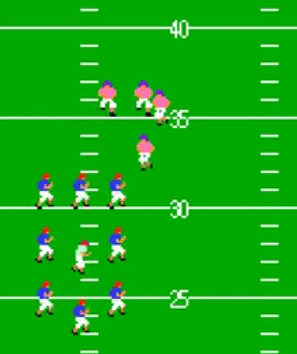
Game Review: 10-Yard Fight

Hey guys, it’s Kernook here, and it’s time to talk about a little game that’s hardly remembered these days called 10-Yard Fight. This is a retro sports title that revolves around American football. I really must say, retro sports games like this one are special due to their antiquity. Games like this one only offer a useful look at what gaming used to be.

That reflection is important, but that’s about all 10-Yard Fight has going for it. This is a basic football simulation game. You might get a little fun out of the novelty of playing such an old title, but you’ll also get plenty of little annoyances. More on that later.

When I say this game is old, I mean it is older than the NES itself, type of old. This game is absolutely geriatric by gaming standards any way you look at it. 10-Yard Fight was developed and published in Japan by Irem. It was originally for arcades in 1983, not consoles. It finally came over to the NES in 1985. Honestly, playing the game feels just as out of place as you might expect.

Like Anime, Gaming, and RWBY Analysis content? Check out our other platforms and support our content. Please don’t forget to follow our blog for more content like this.

Click to Donate

You can help support us through PayPal or Patreon.

The sound isn’t the greatest, the visuals aren’t either. Just looking at the field itself, the little players skittering around lack a fair bit of polish even for its time. There’s a lot of important gameplay features missing here too and these days it makes the game even more annoying to play.

The game doesn’t even have the standard playbook or the season modes you might expect from other games of its genre. You won’t get team names, or any detailed customization of the team itself, either. The difficulty settings are also bare bones at best, vague at worst.

Obviously, the game has not aged well under the hood, either. The artificial intelligence in the game (AI), can’t predict even the most basic strategies. On easier settings, you’ll be able to outmaneuver it without much effort at all. On harder ones, sometimes it feels almost random. Once you get used to the learning curve of the game itself, there’s really nothing more to do. It becomes a glorified fidget toy.

I suck at football games (and arguably all games in general), anything besides Tecmo Bowl may as well be me kissing my butt goodbye. 10-Yard Fight is lackluster in comparison, and you don’t need to be a top tier gamer to see that.

Then again, we’ve been spoiled by gaming these days, let’s not forget that. I’m sure that 10-Yard Fight was probably a wonderful game at one time, likely beloved by football fans who got to grow up with it… but therein lies the problem for me.

I was born in 1989, so clearly I missed out on those early glory days. There’s a reason why Tecmo Bowl stands out to me as one of the better retro football games. It was the game I grew up with, and the one I was introduced to in my earliest days as a gamer.

Is 10-Yard Fight objectively a good retro game? Well, the jury is out on that when we put the game under scrutiny… it’s old, and it lacks a great many features that we’d expect these days. We’ve got to cut it a little slack at least. After all, it is one of the earliest first football games out there for a console in the first place. We can’t exactly expect the sun, moon and stars here.

That being said, it’s important to look upon gaming’s history, and to me 10-Yard Fight is one of those historical landmark titles often forgotten about. So, no, it isn’t complete and total crap from a historical standpoint. We could hardly appreciate later iteration of football titles without understanding what we lacked before those things became commonplace.

If the history of games appeals to you, and you are a football fan, it may be worth it to try the game for yourself… but if you actually want a good retro football title, then almost any other game would do you better. Clearly, I’d suggest 1991’s wonderful SNES game Tecmo Bowl.

This has been Kernook of The Demented Ferrets, where stupidity is at its finest and level grinds are par for the course. I’ll see you next time.

Click to Donate

You can help support us through PayPal or Patreon.

Meanwhile, check out some of our other great content below. You can also find more information about supporting us at the bottom of this post.

Game Review: Resident Evil 3: Nemesis

Like Anime, Gaming, and RWBY Analysis content? Check out our other platforms and support us!

Click to Donate

You can help support us through PayPal or Patreon.

Hey everyone, it’s Kernook here. By now, it should come as no surprise to you that I’m a huge fan of the Resident Evil franchise, and Resident Evil 3: Nemesis from 1999 is by far my favorite title in the old series of games. I love this game, and I return to it often on my PlayStation that has seen far better days.

That being said, Resident Evil 3 is not a perfect game. Objectively Resident Evil 2 stands as the far better game, and the reasons why I like Resident Evil 3 are personal to me. Don’t worry, I won’t be speaking through rose tinted glasses here. Just because it is my absolute favorite, that doesn’t mean I don’t see the flaws.

The game has some very clunky elements. Questionable decisions were made that just don’t allow the game to have that same polished feel that its predecessor had. The game is certainly a step sideways rather than forwards when it comes to enhanced gameplay.

So let’s dive in and take a look at this amazing game, and why it fell a little short.

The Burdens of an Acclaimed Reputation

As I explained in my Resident Evil review, the game was a spiritual successor to Sweet Home, and the birth of survival horror as a genre. Due to the huge success, a second game came shortly after, and the fans clamored over all of the wonderful new additions Resident Evil 2 had to offer.

In the late 90’s Resident Evil had proven itself to be a series that was beloved by gamers everywhere, and this made it a hit. With two widely successful games in the series so far, and sales filling their pockets, Capcom knew they had a real gem to work with. A few spin-off games were already in production, but Capcom didn’t want the fans to wait too long. This resulted in another developmental kerfuffle.

They had faced one of these controversies in the past. I’ve highlighted that particular mess with my review of Resident Evil 1.5, which you can read here. The short version is this; Resident Evil 2 had a prototype that was scrapped due to disagreements in the development process.

Ultimately, this resulted in a lackluster game that was never finished. This prototype is loved by a select few, and is known in the fandom as Resident Evil 1.5.

Those still on the team at the time revitalized the game from the ground up. This was the right decision, making Resident Evil 2 the success it stands as today. Upon release, it quickly made incredible sales numbers. Many fans argue it’s the best game in the entire series, and really among the classic games it is very hard to dispute this fact.

Anyway, perhaps these past lessons about rushing the development process hadn’t been learned. Two spin-off titles were being produced at the time, and instead of making an entirely new title, both of these spin-off titles were in the running to take the place as the third official entry in the series.

For clarification, one game was Resident Evil: Nemesis. The other was Resident Evil: Code Veronica.

Quite frankly, I believe this is the core issue with a lot of the problems the game has. It stands to reason that taking a spin-off title and trying to contort it into a main story leaves, much to be desired.

Side Note: A Theory I Have

To be honest though, I don’t think the rush to release a new title was entirely unsound. Even though I do think the game did suffer a bit because of it. I’m sure that the precedent set by the swift release of prior games made the developers and the production staff behind the game feel a true sense of urgency.

Other horror titles were also in production by competing studios at the time, and this likely had a part to play in the decision to rush to a release. The games slipping into the market would promise some very heavy competition. What games you ask? That’s a very good question.

There are a few, but namely Silent Hill comes to mind as one such powerhouse title. It was in production at the time, and saw an earlier release in 1999 as well.

I can only imagine that the knowledge of Konami working to release Silent Hill in a timely manner, and Squaresoft releasing Parasite Eve in 1998 proved to Capcom that their hold over horror games on the PlayStation could be considered fickle at best. It is merely a theory, but I’m sure this contributed to some of the rushed decisions we ultimately see when in regards to Resident Evil 3: Nemesis.

What is important to remember is that while there were many horror titles in the original PlayStation era, few series were as popular, or as widely loved as Resident Evil or Silent Hill.

It is true that Clock Tower comes to mind as one such series that may stand up well against them, but due to gamers already knowing of that franchise as early as 1995, it’s hardly a fitting comparison. It released before the first Resident Evil had even seen the light of day, and Clock Tower already had a strong fan base crossing over from other platforms.

The Chosen Successor

From here on out, I will be calling the prototype to the game the “Nemesis prototype”. Capcom eventually chose their Nemesis prototype to become the third game in the series. It would proudly bear the number three upon it’s front casing, with the titular monster standing menacingly behind the title. When fans saw the game, we were hyped, and we just couldn’t wait to get our hands on it.

The game is known to us now as Resident Evil 3: Nemesis, released in September of 1999.

The issue is, this game was crafted to be a spin-off title first and foremost. It was never built or conceptualized to be a main series title. Originally, it had been handed to a small, and frankly very inexperienced team of people. The sort just getting their feet wet with larger and widely loved titles.

There was little knowledge among the group when it came to the vast lore of Resident Evil as a series. The game was intended to star an entirely new character, attempting to escape the horrors of the city now infested with zombies. However, this creative choice would not stand well against the already released and widely popular Resident Evil 2. The story was just too similar in thematic beats and story telling.

With two games out and set in stone, it was imperative that the next story reflected the already loved and established characters. With stories that hadn’t been entirely finished yet, the world needed building. The environment and threat from Umbrella needed to be extrapolated upon. When the “Nemesis Prototype” was chosen, and it underwent an exclusivity deal with PlayStation, cementing it firmly in place.

From there the wheels began turning into motion. Key plot lines were changed to include Jill Valentine from the first game as the main character for this new title.

She was chosen because she could still escape the city, and tying the story in closely with the events from the second game allowed many of the thematic elements to be kept from the initial prototype. They could still keep them well in-hand, without crapping all over the general premise that the “Nemesis Prototype” started with.

Shinji Mikami stepped in to help, as his previous experience gave him insight as to just how the game should be produced. Ultimately, the game is a mixed bag. Now let’s discuss why.

Story Troubles

Resident Evil 3: Nemesis makes the entire Resident Evil lore a bit messy thematically. Some parts take places before the events of Resident Evil 2. Meanwhile, others take place during the events, and some take place after the events. This makes the game stand as a strange narrative window into almost all of the early Resident Evil plot lines.

Jill is a former S.T.A.R.S. Alpha team member. She is coined by Berry, another teammate as the maser of unlocking.

In the first game, what started as a search for missing Bravo team members went south when monsters chased the group deep into the forest. Taking refuge inside the mansion, sinister truths began to unfold as zombies and other monsters run rampant.

At the start of Resident Evil 3: Nemesis Jill recounts the events. When the team returned to report what they’d seen at the mansion, the truth wasn’t received well. Due to the mishandling of information, and conspiratorial cover-ups, the dangerous T-virus has run rampant in the heart of the city. Now she must survive the hordes of zombies all over again.

Umbrella wasn’t going to go down without a fight. They had a new master plan. The pharmaceutical company gone wrong had a new bio-weapon they’ve been working on. This one is intelligent and deadly. Releasing it into the city streets, they’ve given this abomination one single mission. To eradicate remaining S.T.A.R.S. team members, and this creature will prove to be Jill’s most dangerous opponent yet.

As she calls it “My last chance, my last escape“. She attempts to flee the city, and bring light to these new horrors. During her escape, Jill teams up with a member of Umbrella’s own mercenary unit. A man by the name of Carlos Oliveira.

While it’s true that plot line itself is fairly straightforward, trying to break down exactly when certain events take place in relation to Resident Evil 2 can be a bit difficult. Thankfully though, this only really influences the most die-hard fans. An average player won’t be impacted by the questionable bits of lore buried deep.

Resident Evil has never really had the knack for complicated storytelling, particularly in it’s earliest games. What makes the plot of Resident Evil 2 so good is that it is very cleanly cut and masterfully written upon those surface level ideas. The details embedded into the core of the game need not be considered by the casual fans, and I think that has a lot going for it.

Meanwhile, Resident Evil 3 just can’t hold up as well. It can be too easily compared on a surface level, and to differentiate the game from its predecessor you need those finer details and several times playing the game due to branching paths. I’ll get to that later. For now the only point I want to make here is that most titles in the franchise linger on the surface elements.

That is where most gamers will collect the vast majority of the plot elements, and Resident Evil 3 fails to accomplish surface level storytelling. You need to be willing to dive deep to get the best out of it, and that shouldn’t happen in a zombie shooter.

This game requires that you understand the entire lore of Resident Evil up to that point. The events at the manor play a large role in the backstory. The corruption between Umbrella several key characters from the previous two games can’t be understated either. If you don’t know of these games, you likely have no idea what I’m talking about. That’s my direct point. The devil really is in the details on this one, and that makes Resident Evil 3: Nemesis much harder to simply dive into blindly.

Nemesis or Mr. X Clone?

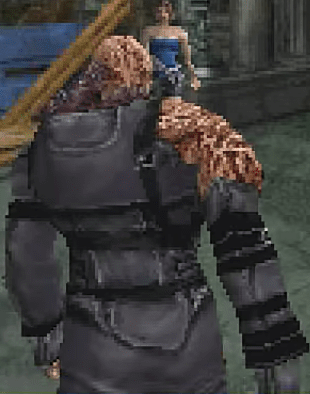
Welcome to the devil within those details I mentioned above, the main big baddie of the game. This is another point of contention for the game. Nemesis is a clunky bugger on a good day, but we’ve already seen his mechanical style before. He chases the player in key moment of gameplay. Sound like something we’ve seen before? Well, it should because Mr. X does this during Resident Evil 2.

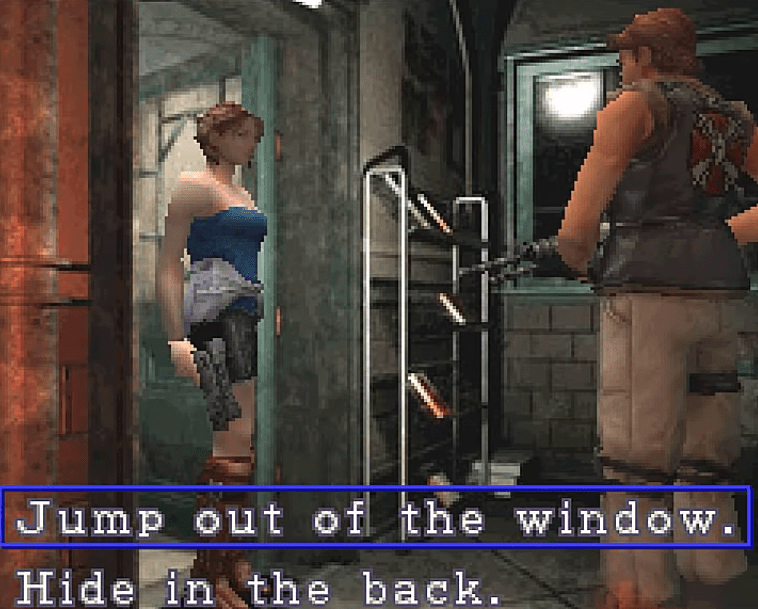
Many times when Nemesis crops up, the player can choose to fight or run away. Some battles are scripted boss battles that can’t be avoided, but there are plenty of times you can just run away too. This is a good time to discuss the multilayered storytelling, and the choose your own adventure style of gameplay. Occasionally, the player will encounter a moment when time slows down and the screen fades a bit to a whiteout.

Two choices will come onto the screen, and you have a few moments to choose one before the game picks for you. Doing nothing will always choose the option highlighted first. These moments don’t always include Nemesis, but it happens often enough with him that this is as good a section as any to discuss it.

I think this is why I love the game so much, and why it is my favorite. The layering of complex choices upon a first or second run of the game are staggering. For example, the first time this happens is an encounter with Nemeses. You can choose to run away, or you can choose to fight him. Here’s the funny thing though, you don’t have to fight him even if you choose the option to do so. Instead, you can run up to the dead body of one of your teammates and collect his identification card so that you don’t have to find yours later.

After grabbing it, you can run inside the police station and avoid the fight. Or if you choose to fight him accidentally, you can just run inside the police station anyway having done nothing.

This sort of complex narrative is done through player interaction, and it builds a very distinct style of gameplay that just can’t be overstated. You have options, often times way more than you think you do. Being creative and thinking about how best to tackle a situation is the core of the Resident evil formula, but here it really thrives.

How you choose to play after you’ve made a clear cut choice matters. It can and often does split the narrative path.

This matters on a personal level, and tactically it offers a far more robust gameplay experience on top of it. Without this key detail, Nemesis would certainly be a Mr. X clone many claim him to be. However, because these events are so often tied to a Nemesis encounters in some way, he’s absolutely not a clone, he stands on his own merits.

Your choices change some of your item pick-ups, bits of the narrative, and other small details. Each choice gives you a lot of tiny tactical options. Therefore, I firmly stand on the opinion that Nemesis is a much more improved villain over all. This is simply because the main story ties to him in a way that Mr. X could never hope for. Mr.X is an on rails experience, and he feels that way. Nemesis is on rails too, but at the time the game released he didn’t feel that way. That’s the difference here.

That being said, I still stand by what I mentioned before too. A casual player will miss out on the value this can offer. This concept is made for a hard core Resident Evil fan first and foremost. If you’re not going to think around the choice you pick, or you can’t think fast on your feet with all of the previous knowledge of Resident Evil games you should have by this point, most of the super small details will be lost on you.

Tank Controls and Dodge Maneuvers

Let’s talk about the new mechanics and the old. You know the game looks good for it’s time, even if it looks a bit trashy nowadays. You also know the soundtrack had to be good, and that’s a fact too. Typewriters and ink ribbons return, as well as all of the other stuff from previous games. There’s not much new here, though now there’s a gun powder system, that’s fairly standard and expected in the franchise now. Back in the day it was really cool, but why gush about something we’ve all been exposed to by this point?

So, we go to the core contentious mechanics that heavily influence the fandom. The Tank controls, and that dodge mechanic from hell. First however, let’s discuss something very few people bring up, in a segment I like to call “zombie eats bookshelf”. See for yourself…

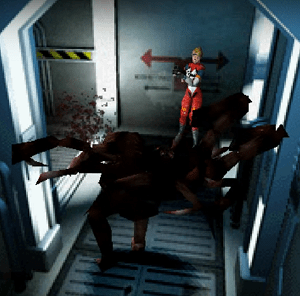
See the zombie? See that bookshelf? He does that every single time! Without fail, I have yet to see him not have a go at the bookshelf instead of me, the fleshy person he should be after. This zombie absolutely loves that shelf. He won’t ever attack me unless I stand there long enough for him to figure out how to turn around. All of the other zombies could be dead, and he’s still playing with that shelf. Every single time, on any play through. He is not the only zombie to favor a wall or some other object either. The zombies are dumb, very, very dumb.

The enemies have never been too bright in these games, but certain ones are regularly more stupid this time around. It’s a real issue in this game because I notice it more in this one than in previous titles. This zombie tends to be the worst of them, which is why he gets the spotlight for most idiotic bullet sponge in the game in my opinion.

Okay, now then, onto take controls. I’ve said this before but tank controls deserve to be a gameplay choice, and I will 100% fight on that hill until the day I die for one simple reason. For me, it makes many games easier to play and enjoy. It doesn’t suit all gameplay styles though, and Resident Evil 3: Nemesis proves this in spades.

Now the tank controls themselves are fine. There’s nothing wrong with them even slightly, however a new gameplay mechanic was added that is without question very problematic. This little piece of unholy garbage is known as the “dodge maneuver”, and it’s just as crappy as you’d think it is by name alone.

What make tank controls fun for me is their predictability in the right sort of space. I know that when controlling my character, it will only run forward in very specific ways, and turn under very direct parameters. Tank controls aren’t a fluid control system. That’s why I like them.

However, the dodge maneuver takes everything I love about tank controls, and it ruins them. First of all, not only is the move clunky, it is very unpredictable. You might as well just send your character directly into the enemy you were trying to avoid. Trying to dodge will likely do it anyway, the thing is useless to anyone who isn’t a seasoned pro at the game.

The maneuver isn’t exactly player friendly, not to mention entirely not needed. That is the maneuver’s only saving grace. You don’t actually need to use it, and you can beat the entire game without having to use it at all.

Yep, you read that right. We don’t need this thing, the good ole fashioned Resident Evil “bait-and-run” works well enough on zombies. It’s the tried and true method. As for Dogs and other dangerous enemies, your old skills in previous games will serve you better than that maneuver.

Stop, look, and listen in every new area. All of the old hallmarks are there, including obvious warnings and attack patterns. Yes, some enemies move faster in this game sometimes, but you can and should be outsmarting or outrunning them. Classic Resident Evil has never been about blasting your way through everything, and it’s not about that here either.

If you ignore the dodging mechanic will you take a few hits? Oh yeah, sure, you will. However, you probably would have taken just as many, if not more hits just by using the damn maneuver anyway. You can still get the best rank in the game, never having used it once. Leave that thing to the top tier speed runners, the rest of us don’t ever need it.

Virtues of Easy Mode

This is the one and only game in the series that I will praise for having an easy setting. In most other Resident Evil games, having an easy mode only makes enemy placement or some puzzles easier to contend with. Enemies in these games are “bullet sponges” nine times out of ten on harder difficulties. Killing certain zombies qualifies as a strategy, and you don’t earn your Resident Evil stripes unless you know what zombies will screw you later. In Resident Evil 3: Nemesis, though having an easy mode set up the way it does actually has replay value.

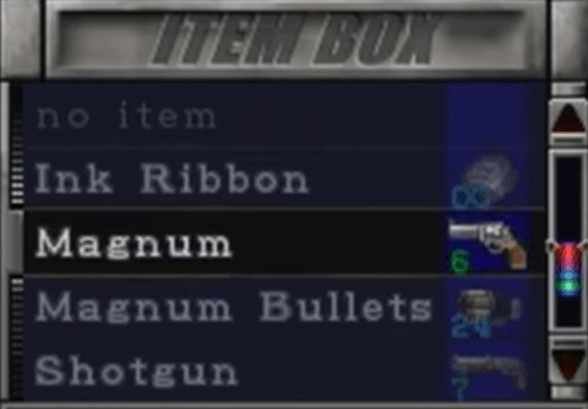
On this mode, you’re geared out hard core. You have a wealth of bullets and ammunition at your disposal, and you can basically blast your way through the entire game. Unlimited ink ribbons and even coveted Magnum rounds are in the first item box you come across along with a slew of other healing items and weaponry.

You don’t have to play by the rules. You can run the early game with that high end weaponry. With unlimited saves, and more firepower than most people would ever know what to do with, this thing isn’t exactly an “Easy Mode” as much as it is a “Fun Mode”.

I’m actually kind of sad not all the games utilize this mentality, because easy mode turns Resident Evil 3: Nemesis into a glorified fun house and there’s something to be said for just toying around in the game every now and then.

In other games, this would be the worst idea possible, but Resident Evil 3: Nemesis has branching paths. Having a mode like this allows even the most casual players to see all of the options without investing too much time into the game. They can just recklessly blast their way through with no loss of difficulty later when they play for real.

This mode is far too easy to prepare you for harder difficulties, so the addition hurts nothing. Enemies basically melt, and your item boxes are bursting with all the equipment you need to thoroughly trounce Nemesis in every encounter you have with him if you’re even halfway competent. If you want the true ending, you still have the play and beat the game on the hard setting with absolutely none of the advantages easy mode gave you.

After playing easy mode, the curve in difficulty will be absolutely astronomical for the unsuspecting player.

As much as I love the typical way to play the game, I’ve got to admit, toying around in easy mode every now and then isn’t half bad either. Yeah, there’s absolutely no real difficulty at all, but it is fun. It has a real place here, and this is the only Resident Evil game where I will praise its inclusion.

Final Thoughts

This is a hard final thoughts to write. It doesn’t come easy to me, because I love this game, but at the same time it is a mess beyond words sometimes. I guess that’s the acknowledgement I need to give it. Let’s do that, then.

Let’s end right back where I started. I’ve said it before, I’ll say it again. Just because Resident Evil 3: Nemesis is my absolute favorite game in the classic series, that doesn’t mean I don’t see the flaws. I do, trust me, they’re everywhere.

The game is a mixed bag. I’ve praised it, I’ve bashed it, and I still can’t help thinking that my not so favorite zombie will still toy with the bookshelf next time I play the game. I’ve got my complaints with the game mechanics, and yeah the story was a bit clunky. Nemesis isn’t perfect, and although the branching paths are my favorite part of the game personally, I can see why people wouldn’t like them.

When you boil it all down, the game can’t possibly stand on the same level of quality as Resident Evil 2. There’s no denying it, I won’t try. The game was a major letdown for a lot of people. They had high expectations, and the game couldn’t live up to them.

Still, it’s not a complete failure either. This game had a lot of things going for it, and it was nice to have Jill back for another main series title. The easy mode is pure fun to play, and the freedom of gameplay and narrative choice surpasses both of its predecessors by far.

That being said, Resident Evil 3: Nemesis is the game that I like best. At least when it comes to the classic Resident Evil titles. I can’t urge you to play it, objectively it just isn’t that earth shattering. I refuse to tell you to avoid it, because I like it too much, and maybe someone else will to.

This thing is a very old game. If you you must play every Resident Evil game out there, pick it up and enjoy. If not, that’s okay too. Don’t feel like you’ve lost your chance at a true piece of monumental survival horror history. This game isn’t like the ones that came before it. Resident Evil and Resident Evil 2 have the claim to fame, and those are the ones you should pick up if that really matters to you.

You can check out some of our other content below. I hope you find something you enjoy. Also, please consider following our other platforms and supporting us on Patreon.

This has been Kernook of The Demented Ferrets, where stupidity is at its finest and level grinds are par for the course. I’ll see you next time.

Click to Donate

You can help support us through PayPal or Patreon.

Meanwhile, check out some of our other great content below. You can also find more information about supporting us at the bottom of this post.

With your contributions, you make our efforts possible. Thank you for supporting our content. Patreon supporters receive access into our official Discord server, and a few other perks depending on the tier. If you don’t care for Patreon, and don’t care about perks, you can always support us through PayPal too… links below.

Those who join via Patreon get special perks, such as extra content, quicker updates, and more.

Click to Donate

To Our Supporters

Thank you for helping us to enrich our content.

Patreon Supporters:
($3) Little Ferrets: None
($5) Demented Minions: Andrew Wheal.
($7) Fandom Ferret: None
($14) True Blue Ferret: Francis Murphy and Bryan BSB.
($25) Premium Ferret: None.
($50) Round Table Ferret/Fluffy Ferret: Josh Sayer

Game Review: Silent Hill

Hey everyone it’s Kern here, and today we’re going to look at an old classic. A game that probably doesn’t need an introduction for being one of the most bone chilling experiences for keeping gamers up at night.

In the 90’s, survival horror began to become an iconic genre that spilled into the gaming market. People all over the world wanted to sink their teeth into something a little more unsettling than the average shooter, platformer, or role-playing game of the time.

Silent Hill is one of those classics that likely doesn’t need an introduction. If you were into horror as a genre and loved gaming back then, this was probably one of the games you picked up to play. I know that I did, that’s for sure.

Game consoles of the 90’s such as the PlayStation could support better graphics, and PC gaming had been receiving plenty of its own horror classics for a while at that point. However, those of us on consoles needed to catch up, and we needed to do it fast. Thankfully, two types of horror franchises lifted from the shadows to meet this demand. Both of these titles hit the ground running, but they were vastly different in nature.

When 1996 came around, Capcom released Resident Evil. The horror title showed gamers just what they could hope for when it came to survival horror. It coined the phrase, and that successful effort would change the social sphere of gaming as we knew it.

Konami was hot on the heels of this new bandwagon, and they jumped into these new possibilities for gaming feet first. They aimed to make a game that could become Resident Evil‘s direct competitor. They knew this would not be an easy thing to do, as Resident Evil had cornered the market fairly spectacularly in the horror genera in one single game.

They wanted to create a cinematic game-play experience first and foremost. With this in mind, “Team Silent” was formed with a ragtag production crew. These were people with big ideas and bigger personalities. They didn’t necessarily fit the creative mold that others in the industry did, and that is why they were chosen. There was only one small issue…

The members of “Team Silent” had no idea how to go about making their new game. Horror games were not the staple that they are today. Survival horror was a newly coined term, and it was unknown territory. The team felt the weight of their task weighing down heavily upon them. They had the skills, but they had no idea how to apply that knowledge to a horror title. These once bright-eyed game enthusiasts began to become discouraged under the pressure.

Like many developers do, they began forging their own path. In the end, they ended up choosing a much more subdued narrative for their story. Something far more contemplative and vague than Resident Evil could ever be. All of their efforts eventually paid off, providing a game that split horror fans down two distinct paths.

Each path worthy in their own right.

While zombie fans had Resident Evil to keep them awake at night, others were hungry for something darker and thematically deeper. These fans had a different game to call a masterpiece. This game was known as Silent Hill.

As a gamer, it’s hard not to have heard of these two powerful franchises. While many consider both games it under the branch genre known as survival horror, Silent Hill is far from it. No, this game is without a doubt a psychological horror series.

Released in the early part of 1999, Silent Hill offered players a different type of experience. Unlike its zombie infested distant cousin, this game provided a look into unsound minds.

This game boasts a compelling narrative that wasn’t so simple to unravel. There are still questions left unanswered when it comes the lore of the game, meaning that new players to the series can still find it enjoyable.

With several games, decades of terrifying fun, and a spin-off movie, Silent Hill is by far one of the most fondly remembered franchises that requires a reboot.

For a while, fans even thought we were going to get that reboot when “P.T. Silent Hills” came out in 2014. It was a terrifying playable demo that has it’s own complicated story to tell.

I only wish to give it a brief mention here, because if I didn’t it would be a huge disservice to my love of the franchise, and everyone who worked so hard to bring fans another taste of the franchise.

Sadly, for many reasons, the reboot just wasn’t meant to be. Still, the legacy of Silent Hill, and the franchise as a whole, is something that should be remembered. Both for some of the best gaming in history, and some of the greatest failures later titles provided within horror as a genre.

Surface Level Shenanigans

It’s hard not to know at least a few fragments of Silent Hill‘s story. It may as well be a campfire tale, spoken with flashlights in hand while eating marshmallows with friends. Even so, the concept is effective for sending chills down any spine. The problem is, most of the story is left up to interpretation, and that’s by design. Silent Hill’s creator Keiichiro Toyama, made sure that the plot is as consistent as it is vague.

This writing style is a great way to spin fan-theories, and conjure about what goes on in the game. Unfortunately, since so much is left up to interpretation, and there are multiple endings, not everyone views the events of the game in the same way.

There will always be debates surrounding Silent Hill, and that’s the way it was designed to be. Just keep that in mind as I gloss over the very basic story.

There lingers a fictional town somewhere along the foggy shores of Toluca Lake. Within this small and seemingly insignificant location, a quaint little community resides here. One that probably fell on hard times and left forgotten about. It’s not likely one to attract a boat load of tourists any time soon, but something about that little town is compelling anyway.

As if the town has a voice of it’s own, it sings an almost sirens call. Unfortunate souls are attracted to this gloomy place. They find themselves wandering through a pit of dark truths, and murky discoveries. That sad, destitute little town, is known as Silent Hill.

You play as Harry Mason, a single father who’s on his way to Silent Hill for a small vacation. While driving at night, Harry swerves his car out of the way to avoid hitting someone that seems to be standing in the middle of the road. After waking from the crash, he notices that his daughter, Cheryl has gone missing. With snow littering the ground and fog thick in the air, he sets out to find her.

While Harry attempts to find his daughter, he wanders into the town. There he meets a police officer who attempts to help him, and eventually finds himself entangled in the dealings of a cult that seek to manipulate Harry for their own goals. As the game continues, players realize that the town of Silent Hill may as well have a life of its own.

However, all of that is only on the surface… The game has a deeper story… A darker one… I shouldn’t have to say this, but beyond this point, there will be spoilers.

A Town’s Sinister Tale

The above summery alone makes for a compelling story, but it isn’t the complete story. It’s not anywhere close to it. Instead, it’s a fabrication, made to lure the player in. Remember, this is a psychological horror game, and the story itself is intentionally vague. Nothing is as it seems.

I am now going to gloss over the actual story of the game, and if you haven’t played it before, you may struggle to keep up. This is not a simple premise, and it was never intended to be.

Contrary to what you might think given the details above, the story isn’t one about a father looking for his lost little girl. Even though you play as Harry, it’s not his story that begins to unfold as the player progresses.

Instead, Silent Hill is all about a little girl named Alessa. This little girl was born into the town’s religious cult. This messed up collection of demon enthusiasts preach a far different bible story than usual.

Apparently, the god they speak about returned to the heavens before the world was done being created. This ultimately lead to a flawed, and imperfect design. This god then promised to return one day.

The cult aim to speed up their god’s return the best way they know how. The crazy old lady, Dahlia is the current leader of the cult. She has the idea to use her own child as a means to do it. Unfortunately for Alessa, Dahlia isn’t just the cult’s current leader, she’s also her mother too.

Alessa has psychic abilities, and Dahlia believes that they can use that to impregnate her with god. Let me say that again. Dahlia, crazy person that she is, thinks that she can get her psychic daughter pregnant so that she will give birth to their god.

Obviously, it should come as no surprise that this plan fails spectacularly. The stress of the ritual forces Alessa’s powers to activate, causing catastrophic damage to Alessa, and her powers. During this messed up series of events, Cheryl is created. Once she is, Dahlia can no longer complete the ritual.

To make this explanation as simple as possible, the cult needs Cheryl and Alessa to reunite if they have any hopes to complete the ritual so that their god can be born. Alessa refuses to let that happen, and does everything in her power to keep the cult’s plan from coming to fruition.

Why does this matter? Simple, because the mechanics act as a metaphor for this story.

Everything in this game has mechanical weight that means something to the greater plot. For example, the story I just detailed above is the explanation for the “Otherworld” which is a commonly visited mechanic in the game.

After playing the game enough, you can figure out that the “Otherworld” is merely Alessa losing control of her powers and her mind every now and then. When she does, her mind allows the darkest parts of her torment to seep freely out into the world.

The monsters that players see are physical manifestations of this poor girl’s suffering. The puzzles are tied to her intrinsically. When you look at the game through that lens, everything begins to come together and make a lot more sense.

Most of the characters are mechanical in nature too. The side cast carry the weight of monologue heavy diatribes. The few actual characters you run into are unstable at best. Some characters openly lie willingly, and others will merely offer a version of the truth. As I said before, the town itself might as well have a life of it’s own, and it certainly seems that way as each person you meet continually muddies those narrative waters.

Harry himself is merely the vessel the player uses to understand this sordid tale. Cheryl acts as the simple narrative device that new players cling onto as the story unfolds.

Intuitive Design Done Right

It would be easy to assume that since this is a horror title, that it would have game design that felt similar to Resident Evil. That assumption would be incorrect. While they’re both horror titles, the way they display that horror is vastly different in context and narrative style.

There are a lot of the same hallmarks to horror series sprinkled in the game. Limited ammo, puzzles, and exploration are all part of the greater whole, but in very different ways.

At the time of the game, clunky controls were the staple for the horror genre. To some degree it is a hardware limitation of the time. They make a reappearance here as well. Thankfully though, it’s not as clunky in this game as its survival horror counterparts. I wouldn’t call them “tank controls” exactly. However, that said, running can be a chore on occasion.

Harry moves decently fast once you get him running, but you can’t always outrun every single enemy in the game. Some of the hallways are too narrow for the usual Resident Evil style bait and dodge. This means being prepared to stand your ground tactically. With this in mind, let’s discuss how to survive.

Weaponry isn’t just limited to guns and knives. There are plenty of objects to pick up and use as well, encouraging trigger happy players to take a different approach when it comes down to selecting weapons. Each weapon has its own “recharge” time, so to speak. Some weapons are faster than others, so learning how to time an attack is crucial to a successful enemy encounter.

Ammo should be saved for the larger fights, while other other items can be used to take down a lone enemy or two. Like Silent Hill‘s survival horror cousin, the best choice is to conserve weaponry and just run away when you can. However, because you can’t outrun everything, the average player will need a good stock of weaponry for those unavoidable encounters and boss battles.

As shown above and here as well, some spaces are tight and claustrophobic.

The camera accommodates this aspect well, adding significant tension to any environment. When it comes to the camera itself, it tends to be smooth and easy to control. No forcefully fixed camera angles here.

This allows for easier navigation, and comfortable coordination while in combat. There’s just one downside, it is a very a slow camera. This means anticipating where you’d like the camera to be is a skill players will come to learn quickly. The camera will move on its own to a decent spot whenever you enter a new area, and sometimes it’s best not to adjust it at all.

The concept of exploration is vast, and feels closer to an open world, at least for its time. It’s not as sprawling as an open world game is nowadays, but Silent Hill is a vast town, with plenty to explore.

The player is able to access a decent amount of the town fairly early in the game, allowing the player to stock up on supplies early and often. This is a double edged sword though. Stocking up early can give the false impression to new players that you will likely never run out of supplies, but it is very possible, and very easy to do so.

The game itself has a rather linear and set narrative direction. No side quests here, sorry. The game won’t let you venture too far from the beaten path. Once you’ve entered a building, that similar horror feeling will come flooding back to any players of Resident Evil. The hallways are dark, the areas are often crawling with enemies. Puzzle solving and key finding are the name of the game.

In general, exploration and backtracking are a bit more linear and laid out. A few doors in some locations aren’t meant to be opened at all. Silent Hill asks the player to traverse many locations around the town, so this “on rails” approach is slightly required. That said, environments can still be confusing to a newcomer. There are street names to remember, and fog to navigate. Thankfully, as Harry walks around Silent Hill, he’ll scribble things down on the town map. New players should check it early and often for clues and hints.

The “Otherworld” as the characters call it, will crop up from time to time, and the player will have to navigate that too. While it might be the same basic area you’ve been wandering around in already, this world is darker, grittier, and different. Previously opened paths will be cut off from access, and monsters can catch the player off-guard if they aren’t prepared for encounters. Previously safe spaces are no longer safe, and this added element makes backtracking fresh and enjoyable.

The puzzles are difficult, hands down. This is one such puzzle, and one of the most iconic ones. Truthfully, it’s a very common puzzle to get stuck on. Silent Hill offered some of hardest puzzles that a game of its day could provide. They’re vast and several are multifaceted, offering vague hints and very little else. They’re not impossible though.
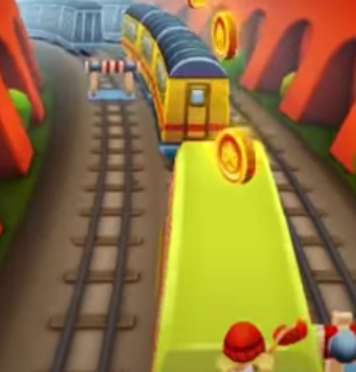
This puzzle here, is proof of that. It’s all about understanding the words that you read, and applying them to a broken piano.

To make it simple to understand, you just need to know three things. White birds are white keys. Black birds are black keys. Some keys are broken and don’t make a sound if you press them. Pushing the keys in the right sequence is how you solve the puzzle.

Puzzles can be solved without looking them up. The game offers you everything you need in order to figure them out. As an added little bonus, the puzzles actually mean something to the core narrative, so they’re not just made to slow you down. They’re made to progress the story in subtle ways.

Unbinding From Hardware Limitations

Silent Hill was praised for its atmospheric dystopia and unsettling visuals. In truth though, the game was designed this way was because it had to be. Due to the limitations of PlayStation hardware, the fog was added to keep everything from rendering all at once. The same could be said for the particularly dark backdrops. Less rendering meant a smoother experience, and faster loading times.

However, this too, became part of the game’s lore. The particularly dark backgrounds in parts of the “Otherworld” were explained by Alessa’s psychic powers. The thick fog that settled over the town was explained as being a product of the nearby lake. The occasional falling snow ties the dreary world together, and helps to make everything much more believable.

On top of that, for its time, everything looks awesome. The careful quality control of visible details were crucial. The game is immersive thanks to each and every environment. Combat is mostly fluid, and each area is truly a spectacle of what horror can accomplish if it is done right.

Characters feel fully realized, although in cut-scenes there can be odd moments when they don’t look quite right. Enemies are fairly disturbed and the horrifying placement of certain details do enough to make a player unsettled as they play.

When it comes to sound, the music is masterful. To me, it is probably the absolute best thing about the game. It is, in a word, iconic. I hear its music and I’m taken right back to the emotions I had while playing the game. Now later titles in the franchise certainly blow this one out of the water, but they were more advanced games, and had a much more powerful consoles at their disposal. With that in mind, the soundtrack to Silent Hill is everything we could have hoped for from Akira Yamaoka.

The voice acting is good, not outstanding, but the actors do their job. Rather, let me put it this way. The voice acting stands up far better than most in horror games of the time.

The only time characters sound weird, is when they should sound that way. It isn’t because characters have a sudden case of inexplicable constipation. Some of the characters are completely insane, and others just aren’t normal to begin with. The acting lines up with that, and really, that’s enough.

Final Thoughts

I do not consider Silent Hill to be a survival horror game. That is my passion when it comes to horror games, and I stand by the fact that it is certainly psychological, not survival.

However, with that said, I have nothing but praise for the original Silent Hill. This game is by far one of the most unsettling games to ever launch on the PlayStation. Furthermore, you’d be hard-pressed to find such a deep and immersive story anywhere else for its time. The story holds up to this day, and the music does too, even if the graphics don’t.

There’s only one reason I have for why a person shouldn’t play this game. It strictly falls down to players who aren’t horror fans. If they’re not, the game wasn’t made or tailored to them, and of course they won’t like it. They shouldn’t go near this thing, if that’s the case. It’s nightmare fuel, plain and simple.

Frankly, I’d say that horror fans who simply want gratuitous gore and simple plot lines should avoid this game too. Particularly if you’re a fan of modern horror that holds your hand and keeps complicated questions of morality to a surface level.
There’s real psychological torment to be found in this game. Abusive situations and trauma linger deeply within the core of the story being told. Silent Hill has gore too, but that’s not the crux of the game. It’s window dressing into the far deeper narrative.

For the rest of us, as in those who occasionally like deeply disturbed horror, this game is worth playing. The experience is unlike any other, and I don’t say that lightly. I could say the same thing comfortably about the first three games in this series. They’re experiences that you just don’t find everyday.

If you like a good horror game, this game is for you. If you enjoy going back to experience classic horror titles in the genre, this game is for you. If you are an absolute diehard fan of horror in gaming, these have to be on your shelf, or someplace in your gaming library. These games are unequivocally made for you.

The original Silent Hill is a true psychological horror game. I love it for that alone. Just like it’s survival horror cousin, Silent Hill has a place on my shelf. It’s earned that place, and all of the acclaim it has received over the years. It fully deserves every ounce of praise it receives going forward too.

It’s 2021 now, and it’s time to put that into perspective. This February, Silent Hill turned 22 years old. Think about that. In America, the game is old enough to have a beer if it wanted. As gamers, we can’t let this game slip into the forgotten corners of our history. It’s too paramount to be forgotten, too important to be bypassed and ignored by younger generations. It’ll slip into obscurity without passionate fans behind it, and that would be a crying shame.

My final thought is; play this game. If you even remotely like horror games with a bone to chew on, experience Silent Hill for yourself. Take the time and do it. It’s worth it. It’s that simple.

This has been Kernook of The Demented Ferrets, where stupidity is at its finest and level grinds are par for the course. I’ll see you next time.

Click to Donate

You can help support us through PayPal or Patreon.

Meanwhile, check out some of our other great content below. You can also find more information about supporting us at the bottom of this post.

With your contributions, you make our efforts possible. Thank you for supporting our content. Patreon supporters receive access into our official Discord server, and a few other perks depending on the tier. If you don’t care for Patreon, and don’t care about perks, you can always support us through PayPal too… links below.

Those who join via Patreon get special perks, such as extra content, quicker updates, and more.

Click to Donate

To Our Supporters

Thank you for helping us to enrich our content.

Patreon Supporters:
($3) Little Ferrets: None
($5) Demented Minions: Andrew Wheal.
($7) Fandom Ferret: None
($14) True Blue Ferret: Francis Murphy and Bryan BSB.
($25) Premium Ferret: None.
($50) Round Table Ferret/Fluffy Ferret: Josh Sayer