Tag Archives: blogger

Pros and Cons of Anime and Gaming Blogs

Hey everyone, it’s Kern here, and it’s about time I sit down and write out a few thoughts that have been on my mind for a while. I love anime, and I love video games. I wouldn’t be spearheading this blog if I didn’t, but it isn’t all sunshine and roses, either. While I’ll be the first to say a lot of good can come out of blogging, I’ll also be the first to tell you that it is an uphill grind if you’re trying to make that blog profitable.

I’m a big fan of blogging in general, but blogging isn’t for everyone.

I’ve decided I’d highlight the pros and cons of blogging about anime and gaming to help you determine if it is the right fit for you. First though, we should talk about what a blog is, and why you might consider writing one.

What is Blogging?

If you want the “big media marketing” answer, it goes a little something like this: a blog is written media that is used to help people interact and learn, trading information based on real-life experiences and data. Blogs are used to help others make a better purchasing decision, or to simply learn something new. While none of that is entirely wrong, I wouldn’t say that’s the main crux of an anime or gaming blog.

Blogging is more than that when we’re talking about hobbies, games and other types of media. For anime and gaming fans, blogging isn’t always about selling something. Sure, it can be about that. More often though, in fandom related spaces, it is about sharing the love of those mediums.

We do this in several ways, from writing reviews and rants, to simply getting the word out about a series we really care about.

So, who should be a blogger?

Anyone who wants to do it, should do it. The baseline to beginner blogging is incredibly low. All you need is a way to write the blog, a site to write upon (even a free one), and a willingness to learn the craft. Sadly, that also means learning to roll with the punches when you’ve got to learn something new.

So, who shouldn’t be a blogger?

Anyone who isn’t motivated to face just a little bit of a struggle. Anyone who thinks it’ll be easy to just skyrocket to the top of google searches and pump out content will be disappointed. Blogging is more complicated than that. Some people will hit the jackpot sure enough. A small number will luck out and trend quickly… but most of us won’t.

The vast majority of us have to do the grind. While the baseline to entry is low, the learning curve to become a blog that earns an income will actually be fairly steep. It isn’t as easy as it looks. Blogging is pretty straightforward, but that doesn’t mean you can be lazy. There is a lot to learn.

Check out this post about my work area.

Blogging Pros and Cons

If you’ve made it this far, you probably want to weigh out your options. Maybe you just want to see what you might be up against. Maybe you already have a blog, and you’ve come here looking for advice. Either way, you’ll find something useful.

I’m going to take a look at blogging from a few key points of view:

  • Early Opportunities and Possible Income
  • Life Balance and Time Management
  • Communication and Networking
  • Other Perspectives
  • Skills You Need

With that being said, let’s jump into the good things about blogging, there’s a decent number to consider.

Pros of Anime and Gaming Blogs.

Blogging, in general, is a gateway used to share content that we enjoy. Each blogger has their own methods. One great thing about blogging is that as a written craft, it can be very fluid. We all have our own writing style, and cadences that we develop across sentence structure. Readers do learn to identify our brand with our particular style.

At the end of the day, it is a way for us to get our voices out there. There are a few perks for those that write blogs, and someone willing to work for the rewards will end up reaping a few benefits.

1. Earning a Living.

For those that just want to use the blogging format as a hobby, you’re in luck. You don’t have to be perfect to simply enjoy the pure power of the written word. For someone who just loves the craft, there’s just not a lot of downsides. Actually there are more good qualities than bad ones. Provided your content can be considered “workplace friendly” then go ahead and put your hobbyist blog onto your CV or resume. It doesn’t matter if it has nothing to do with your particular line of work, if you’re young, use that to your advantage.

I’ll be blunt. Any business with half a brain knows that blogging, social media and proper networking help to make brands more reputable. It also makes you look more reputable if you have a blog about your hobbies that you’ve cultivated slowly over time. If you aren’t going to university, you need every advantage. Even if you only have a small following, this gives you a social media presence as well. Employers like to do background checks anyway.

Bottom line for hobbyist bloggers; give them a bone to chew and a paper trail to follow. Allow your blog to uplift you as a person and you’ll be ahead of the game.

On the flip side, for those who do want to see an income in this medium, it’ll take time and effort. Building a name that can be trusted and learning the nuances of the blogging sphere isn’t a quick thing to do. With blogging, your income is entirely driven by your ability to promote your content and grow your brand. This is what we call “brand awareness”.

If people know of your brand, you’ll be more likely to build an audience and maintain it.

To make money blogging within fan based mediums, you’ve got to find more than just your niche. You’ve got to find your passion and drive that forward in your written word. Even so, yes, there is money to be made as an anime and gaming blogger.

Monetizing your blog can come in all kinds of forms, from affiliate links to advertising traffic. At the time of this post, we don’t use advertising traffic here on The Demented Ferrets just yet. However, it is something we may look into going forward, when the time is right.

You can work on commission based requests once you get your name out there. Beyond that, you can set up further methods like we do here on The Demented Ferrets using other methods such as PayPal and Patreon.

Click to Donate

You can help support us through PayPal or Patreon.

You can support us for as little as $1 a month.

Early on, you may only see pocket change. In this often difficult economy every little bit helps, and it does add up over time. Put those small earnings into savings and let it build up. If you’re wise about it, playing the monetary long-game isn’t a bad thing.

2. Low Monetary Cost.

The reality is, you can start a blog for free on many platforms. With the rise of Medium, it has never been easier to test out blogging for yourself. Plenty of anime and gaming related bloggers find themselves a nice corner of the internet by starting up on Medium and networking out from there. For those who see blogging as merely a hobby, or those looking to put a blog onto a CV or resume, using free platforms like Medium will suit you just fine.

However, if you’re truly invested in starting your own blog, I’d suggest going the paid route and making your own. This will allow you to start a reputable brand image and begin to build the trust you’ll need to eventually get earnings. If an income is what you’re after, you need a brand to stand by.

Building a reputation is fundamentally important. For some of us, that can be a long road, it behooves you to start early and be consistent.

There is some more good news too, hosting is pretty affordable. If you take your time to look into the right hosting providers and site builders, you’re halfway there. You’ll be able to get yourself a blog without breaking the bank.

Remember, if you’re a beginner, you don’t need to break the bank with all the bells and whistles. You can take your time to learn what you’re doing. In light of this, WordPress.com recently reverted back to their old pricing model after their little experiment went awry. They’ve got some affordable price points again, and other places do too… look around and choose the one best for you.

Remember, as a newbie, slow and steady wins the race.

Check out This Blog post on Readability and “The Reading Ease Ideal”.

3. Blogging is a Platform.

Blogging is your chance to have a voice. You can reach out to the wider world and meet all kinds of people by blogging. With time and the desire to interact with others, you’ll find plenty of other people with like-minded interests. When it comes to fandom related content such as anime and gaming, we’re a wide and diverse community, people of all walks of life find their place to belong.

People who blog about anime and gaming, typically love anime and gaming. We’re passionate about these hobbies, and we like to share that with others.

These days, people use big buzzwords like “influencers”, “Instagram models” and “Tiktok stars”. That’s fine, and people earn a living that way too, sure enough. These are all platforms, right along with YouTube, Twitch, Twitter, Facebook and countless others…

It’s easy to forget these days that blogging is a platform too, and that bloggers have our own communities and circles of friends, just like people on other platforms. I’m not always as outspoken in my personal online circle as I should be, but I do the best I can…

Shout-out to Iridium Eye Reviews who is also a variety blogger with anime and movie reviews. Go check them out. Did you know that I once wrote an open letter to him regarding blogging and some of the struggles that bloggers often share in common?

If you’re new to blogging, or just having a hard time as a blogger, go ahead and check out my open letter.

The key point I want you to know is that blogging is a journey. The communities we join really matter to us. We often lift up fellow bloggers when we can, because back-linking those of like minds and content often share communities and readers. It’s important to network this way, and it usually feels pretty good too.

As bloggers, we often come across some pretty cool anime and games that way too… bloggers tend to be readers of other blogs, so discovering new content is always a blast.

4. Blogging is Fun.

Blogging is a creative medium. If you have something to say, then blogging gives you the ability to say it. Many gaming and anime bloggers are purely in it for the hobby of blogging, no matter how big they get. A lot of us just like to do it, and if it goes somewhere, that’s awesome. If it doesn’t, then for a lot of people, that’s no big deal either… we do it because we love it.

Working on our mastery of the craft, namely the power of the written word, is part of the fun. Talking about the hobbies and interests we have can be fulfilling enough on its own. For many of us, that’s reason enough to do it.

A great example of this can be seen by a great anime reviewer known as Irina Watches Anime, who has stated more than once that her blog is only a hobby. She cares for her blog deeply, but it will always just be a hobby for her… and I really respect that.

Guest bloggers share content too from time to time on her blog too, and that’s just another way bloggers help to support and uplift each other. Collaboration and networking really is a key part of being successful no matter what kind of blogger you happen to be.

The Cons of Anime and Gaming Blogs.

You knew this was coming, blogging isn’t all sunshine and rainbows. For as great as blogging is, no matter how much I do love it, there are some downsides. For every good reason to work hard on your blog, there are some reasons you may decide blogging just isn’t for you.

1. Time and Effort

To have a large blog with lots of readers, it takes time and a fair bit of effort. When it comes to anime and gaming, this is particularly true. No matter what kind of blogger you are, this is a somewhat saturated market to get into. That means you’ll have to devote your time to just being noticed.

While the barrier to entry can be incredibly low, the barrier to long standing success is actually fairly high. It continues to get higher by the day. I don’t say that to intimidate you, I say that as a blogger making the up-hill climb personally.

This particular blog is still working its way up the ladder to something completely sustainable. Here on The Demented Ferrets we’re “middling” bloggers. We’re not super popular, we’re not bottom of the barrel. We have a decent and dedicated reader base, and we’re still growing… but we’re not paying all the bills in our homes with this website… not yet.

To be entirely transparent, at the time of this post, we do pay for the website with our earnings and we have a bit of pocket change thanks to our Patreon supporters and other donations. However, we haven’t put all of our eggs into one basket, and you shouldn’t either… not at first.

We also have plans for forward growth and momentum, but we understand that takes time. We all still have day jobs and stream on Twitch as well. From a purely blogging perspective though, it hcan be a lot of hard work. Here’s just a few things that need to be done on a regular basis:

  • Keeping abreast of blogging trends within my niche.
  • Contacting others/networking
  • Topic and planning and scheduling
  • Writing posts like this one
  • Creating new forms of content and collecting the right materials to do that effectively
  • Managing social media
  • Routine keyword research
  • Updating old posts when required
  • Several other mundane but required tasks.

Keep in mind, The Demented Ferrets has a blog with topics revolving around anime and gaming. If I’m doing an anime or movie review, I have to watch the series. If I do a game review, I have to play the game. That’s time consuming, but it is required. I’m not even the best gamer out there, as our Twitch channel so often proves. It helps very little when my cat, Sabin, decides to complicate matters even further.

In any case, blogging is a time investment. It isn’t a “get rich quick” scheme. It’s not a hard and fast solution to all of your monetary woes. I’d say this goes double in the anime and gaming sphere. You’ve got to get into it because you want to get into it, not for any other reason.

2. Significant Amounts of Patience and Persistence

This ties into point number one, but it needs to be its own separate category. Look, I won’t mince words, blogging can be very emotionally draining. If you don’t love it, you won’t be able to commit to all of the things you need to know. Blogging has its own lingo and skill sets that you need to learn.

As an anime or gaming blogger, that gets just a little bit more difficult. We need to know all about the anime and games we write about, and these are two very diverse mediums. I’m going to be honest, the grind is real, and it can be a very good way to snap your resolve as a blogger.

If you expect too much of yourself too soon, you will burn out… and it’s not just writing the blogs, either.

The games you play have their own barrier of entry too. Thanks to exclusivity deals, another barrier is in front of you by default. Your general ability to play and beat a game will be a barrier too. You’ll have to manage your expectations effectively. You need the proper technology to play the game, and that’s an investment in itself sometimes. Then you need to at least play enough of the game to adequately come to a determination on how to properly review the title.

With some games being incredibly long, that alone is a time investment. That’s not even considering the blog post you’ll have to prepare after you’ve played it.

For example, for our play through of The Legend of Zelda: Ocarina of Time it took Ebby almost 24 hours of gameplay footage to do a 100% run…. and that’s just the footage we edited down. That wasn’t even the blog post or video editing that came along with it.

Check out our gameplay post of The Legend of Zelda: Ocarina of Time

Gameplay: The Legend of Zelda: Ocarina of Time

Hey everyone, it’s time for another set of gameplay videos. The Legend of Zelda: Ocarina of Time probably doesn’t need an introduction, chances are good that you’ve heard of it. The game was first released on the Nintendo 64 back…

Anime, movies and television shows have a similar issue. With streaming services snapping up exclusive licenses left and right, watching certain titles legally can sometimes be a pain in the behind. When you take into consideration the “Netflix” binge model, you may as well kiss away an entire afternoon just to watch the series when it comes out… that can take away time from other meaningful things.

It’s easy to find yourself sucked into a void as a blogger. I’d say that gaming and anime have their own occasionally insidious practices. Frankly, blogging does too. These issues can, and sometimes do, build up… it can be a stressful situation, and some people just can’t take the heat.

3. Fandom

I love being an anime and gaming fan, I do. It’s great to meet new people and share experiences. It can be a lot of fun, I pointed that out directly in this post a little while ago. However, fandom like all things, has a dark side. There are times that a fandom might argue or turn on each other, and this is the internet.

It is very easy to lose sight of our own personal experiences and thus, lose sight of the power that these mediums hold… but just as those mediums compel us to write about them, they compel others to feel something just as valuable on a personal level. We can’t forget that.

Fans are simply fans because they feel connected to the things they care about. Their reasons are their own, just as our reasons are our own. Gaming and anime fandom have a distinctive “gate keeping” mentality on occasion, and no matter what your stance on that is, it isn’t going to go away any time soon.

The fact is, when we care deeply about something, it can hurt to feel invalidated by the opinion of another. Readers sometimes lash out and leave nasty comments, that’s a fact. All bloggers that talk about beloved media get a few not-so-nice comments on occasion.

If you blog for long enough, and share your personal opinions about anime or gaming commonly enough, there’s going to be someone out there who will disagree with you. People have bad days, and sometimes they take that out in comment sections.

Occasionally, seeing an opinion that’s harsh upon a thing they’re a fan of, truly is the last straw… and they may not offer constructive criticism in return.

Sometimes, you’ll get a very angry commentator that says some very nasty things… and you will have to deal with that. I’m sorry if this has happened to you, it has happened to me too… and as a blogger, eventually it will happen to all of us. I would say that all bloggers that discuss fandom related topics need to have thick emotional skin, but it isn’t just about that….

It’s about understanding that fandom is a powerful tool, and respecting that tool is part of being an anime or gaming blogger. We are the ones putting ourselves out there, and that’s a hard thing to do sometimes.

My Conclusions About Anime and Gaming Blogs.

Blogging is a journey. You will learn more about yourself, and the content you enjoy. It’ll give you something to really sink your teeth into. It’ll forge your outlook on the things you write about. Creatively, you’ll learn to be a wordsmith, cultivating and creating your own content for the world to see.

Does that mean blogging is for everyone? No, absolutely not.

Gaming and anime blogging requires a rich and diverse set of skills that aren’t exactly inherent to blogging directly. Both of these kinds of media can be a bit exclusionary too, simply by default. Blogging may be cheap, but gaming and anime aren’t always cheap hobbies. Streaming services and exclusivity deals certainly make that just a tad more difficult on occasion.

Anime and gaming fandom have an ebb and flow that can certainly become complicated the moment that a scandal in the industry arises. Crunch times and poor working conditions can cause fandom to run amok. Sometimes they fight among themselves, or aim that frustration outward. Series that are products of a bygone era may be problematic these days, and those are just the surface level concerns to be aware of… does that mean I’m going to discourage you from being a blogger?

No, I’m not… I’m going to do the opposite.

If you’ve read all of that and you still want to be a blogger, then it may be the right choice for you. I think blogging is one of the most rewarding experiences a person can have, because it can teach you so much about yourself… if you want to start up a blog, you owe it to yourself to give it a try.

However, I also think blogging is a challenge. There are times when it can be difficult, and times when you’ll need to puzzle out a problem or educate yourself on something you don’t know.

There’s not really anyone to hold your hand. Unless you know a blogger personally, you’ll be doing a lot of research. Even once you get into contact with fellow bloggers, we don’t always have the answers you might need. We all have our own tactics and methods to this madness, with time, you will too…

I hope this has been at least some help to you, and I wish you luck on your blogging endeavors.

This has been Kernook of The Demented Ferrets, where stupidity is at it’s finest and level grinds are par for the course. I’ll catch you next time. Don’t forget to follow the blog for more content.


With your contributions, you make our efforts possible. Thank you for supporting our content. Patreon supporters receive access into our official Discord server, and a few other perks depending on the tier. If you don’t care for Patreon, and don’t care about perks, you can always support us through PayPal too… links below.

Those who join via Patreon get special perks, such as extra content, quicker updates, and more.

Click to Donate

To Our Supporters

Thank you for helping us to enrich our content.

Patreon Supporters:
($3) Little Ferrets: None
($5) Demented Minions: Andrew Wheal.
($7) Fandom Ferret: None
($14) True Blue Ferret: Francis Murphy and Bryan BSB.
($25) Premium Ferret: None.
($50) Round Table Ferret/Fluffy Ferret: Josh Sayer

Meanwhile, check out some of our other great content.

A Perfect Workspace? Ha, Yeah Right…

Hey guys, it’s Kernook here, coming to you with a behind the scenes look at the blogging lifestyle. What you’re about to see lacks polish, and that’s the point. I’m going to show you what one of my workspace areas generally looks like on a day-to-day basis.

No more, no less than that simple reality.

Now, to be clear, this isn’t my gaming set-up for Twitch. I wouldn’t even begin to show off the absolute mess at the moment. There’s a lot of clutter upon that desk currently that isn’t reflective of the gaming sphere. I was doing video editing, and that takes a toll on my surroundings. That entire office looks like a tornado hit it right at this very second.

I was video editing for 12 very long, incredibly tedious hours this weekend. It’s going to look like that after that kind of grind. There’s a soda bottle graveyard and plates set aside because I need to do the dishes. I’ll be doing that later today… the fact I’ve even said that much tells you what I’ll be doing after I’m done writing this post.

However I do have one other “workspace” that’s still far from “perfect” and likely abysmal to many. However, this is where I write a vast majority of these blog posts, so let’s dive into it.

What you can’t see is that I’m sitting in a rocking chair, but the sight in front of me looks like this:

Yes, that really is an end-table.

A common and flat out stupid misconception is that all bloggers have a perfect workspace, neat and tidy all the time. This asinine idea isn’t always true. We don’t all have the perfect haven to work on our posts. That’s just what we want you to think.

Like all things having to do with “buzzwords”, product management, productivity, or anything else going on, it’s just a fallacy to a degree. We want to give you an image that makes us likable. Let’s be really honest here, how do you think of a blogger?

Are they walking around with a five-o-clock shadow, grumbling at their computer in a lackluster space? Are they gritting their teeth as racket and distraction drives them crazy?

I’d hazard a guess, probably not… but, it’s true. We have lives, families, insanity just like everyone else. Daddy bloggers for example (yes, fathers blog about child-rearing too), I do not envy the one I know personally.

I’ve seen the mayhem. He may be trying to write a post, meanwhile he’s got a ten year old being obstinate about homework, a toddler jabbering nonsense in his ear, and a newly adopted set of twins that aren’t even a year old yet. They demand his full and complete attention as a solid care giver and father.

In the face of day-to-day imperfection that children bring with them, he is still a blogger. Somehow, he manages to be a blogger and keep the household from falling to pieces. He gets dinner on the table before his partner gets home, and his family life is very well put together.

As a blogger though, I hate to say this but he doesn’t even have a desk. No, I’m not kidding. He blogs from his smart phone or on his tablet at the kitchen table. It can take days for him to write a single post, because he has a busy life, he’s a full time dad and blogger about all things fatherhood… but I digress.

He’s still a professional blogger, a breadwinner for his family.

See, people have this image of professional bloggers. Unless we live in a perfect world, perfect household, where there’s never a thing out of place and all the chores in life magically do themselves, those images are staged or sugar-coated.

We’ve cleaned up first. We waited until all distractions from the outside world were out of our way. We’ve taken the BEST Instagram worthy photo that you could… because that’s what we’re expected to do.

Sometimes though, we blog in lackluster conditions. Right now my family is blasting the baseball game from two rooms away, and I am sitting here trying to write a post. The particular Gateway laptop in front of me is over 10 years old and I use it to draft concepts. I toy around with ideas when I’m on-the-go.

It’s a small laptop, so it fits in compact spaces. I do all kinds of simple “puttering” and marginal tasks with it, nothing too complicated.

For the beefier stuff, I have a Chromebook… which, yes, is currently sitting on the foot stool for the sake of the next image. Generally, the thing is in my lap… as I type this, it is in my lap, and will stay in my lap.

Yep, you can see WordPress in the background, because I was preparing to type this post when I decided to take the images… and I took them on the fly, no preparation required.

Why did I do this?

Because…

I want you to see that you don’t have to be like the other bloggers to be successful. If you can write blog posts consistently despite the occasional absolute ciaos or imperfection of daily life, you can be a blogger.

A successful one…

So what else is on that end-table? Beyond the simple technology, you can see my soda glass and my cigarettes with ashes having littered it. Oh, yeah and I should tell you that the Chromebook is the cheap one by the way, not one of the exorbitantly expensive monstrosities.

However, I hope this illustrates the point.

When we see “professional” bloggers online, we like to think all of them have it figured out. A perfect workspace, top of the line gadgets and gizmos, a monogrammed mug, because why not!

What do I have?

Cigarette ashes on the table, and cat hair currently clinging to the outside of my soda glass because Sabin was just trying to get into it. I can look out into my front yard. It’s not a glorious yard, just a normal one.

My backdrop is the racket outside, the neighborhood kids look like they’re trying to figure out how to use skateboards in the subdivision. Meanwhile, my family members are watching a baseball game. It isn’t perfect… it is so antithetical to what we want to see from a “blogger”.

However I am a blogger… more than that I’m a freelance blogger, I make my living this way using freelancing mills under other pen names I’m not supposed to disclose, as writing mills typically don’t like when you do that. Either way, the point stands.

Yes, you can make a living this way without having all of the high-end tech in the world. Yes, you can do the grind it takes to reach success despite that. As long as you come to grips with the “have nots” you too, can be a blogger.

There’s only a few things you actually NEED to be a good blogger, and they’re all low cost to start off, they just take effort. Here’s all you really need:

  1. Some way to access the internet, and something that can let you work with wordpress.com (free site is just fine for a newbie).
  2. A few social media accounts (also free).
  3. Regular access to a computer that can function on the internet well enough to type on (it doesn’t even have to be yours).
    1. Tip: Fresh out of high school I would go to other houses to blog. If you have family or friends, ask around. Do something nice for them in return.
    2. Tip: Use your mobile phone or tablet if it’s powerful enough.
  4. Search up the tools to educate yourself about how to be a blogger; SEO, Keywords, niches, things like that.

That’s it, that’s all you need to start off. Read other blogs, use social media, network often, and even on a free website you’ll start to get the hang of things. That’s the way you want it to be… invest and upgrade when you feel confident enough to do so.

If you can be consistent, start up at a few mills. Yeah, they’ll pay low, it isn’t a get rich quick scheme. Even so, blogging for mills will teach you about the kind of client you want to work for.

I would love it if The Demented Ferrets could become my main source of income. I’d like to spend my time here, full-time… perfecting this space and all that it has to offer. For now that’s just not the case, and I have to pay my bills elsewhere. However, I am a blogger and I do it for a living. A little support goes a long way. If you’d like to help me attain that, you can.

It takes a fair bit of time, but you can be a blogger too. However you need to start slow. If you’re on a budget, get your own free blog. Post up content two or three times a week. Get work at a mill, that way you aren’t tied down to “set hours” in the same way a 9-to-5 is.

Take a client here and there, earn a little pocket change. That will help you to hone your craft, believe it or not. It’ll give you a better taste of the industry at large, and what it takes to be a blogger.

That’s the reality… you don’t need bells and whistles early on. You need hard work and the gumption to try. That’s about it.

This has been Kernook of The Demented Ferrets, where stupidity is at its finest and level grinds are par for the course. I’ll see you next time.

Click to Donate

You can help support us through PayPal or Patreon.

Meanwhile, check out some of our other great content below. You can also find more information about supporting us at the bottom of this post.

Before You Worry About “SEO”, Build Alliances – Here’s How

Hey everyone, it’s Kernook here. I’ve spoken about readability before, and discussed a few thoughts about numbered review scores for and how they can hinder the process. It’s about time to dive into big buzz words.

To be clear though, fancy nonsense like “SEO” and “niches” sound nice. However, they don’t mean a damn thing if you can’t write to be understood.

Go here, learn about readability first.

Assuming you’ve done that, let’s move on. By now I’m going to assume that you’ve got a firm command of the written word. Failing that, at least you know what REI means, and how it should be used. Now, it is time to talk about SEO, or “search engine optimization”, and why newbies need to go slow with it.

In general, big bloggers tell you to test out all kinds of “SEO” concepts on your own. They give you vague hints, but that’s about it. Why do they do this? Well, there’s two main reasons:

  1. Optimizing content for the search engines dynamically changes constantly. We never quite know when the next shift will occur.
  2. They’ve built up strong habits and know how to play the optimization game in the first place.

Guides about SEO that you see on the top page are “updated”, and I use that term very loosely on a regular basis. Yet, to attract the most readers they need to be intentionally vague. It’s kind of like the “catch all” horoscopes you find online. It can apply to anyone… and it’s vague enough to be relevant.

Even when they leave the post alone for a year by accident, that doesn’t matter. As long as they remain on top and you’re the fool clicking on it, they benefit from that click, even when you don’t.

A distant, yet often true third detail is that they don’t want the competition. Here’s the deal, if more bloggers know how to battle against the search engines, that means there are more bloggers they have to compete against.

When people complain that blogging tends to be an over-saturated market, we’re not joking. I don’t care about the competition. In my eyes, if more anime and gaming fans get into blogging, the more we can discuss these rich and diverse forms of media. If you want to be a blogger that’s fine with me.

That being said, I’m going to assume you have absolutely no idea what the major aspects of “SEO” happen to be, or how they’re used. This guide truly is intended for absolute beginners, so let’s dive into this thing.

So, What is SEO?

The acronym stands for Search Engine Optimization. This is a big stupid “buzz phrase” that confounds some of us, and pisses off a vast majority of others. However, it also encapsulates the core foundations required to be noticed on the internet. This includes things like “keywords” that drive traffic to your website.

To put this simply; if you’re optimized in the search engines, that means the little crawlers searching the web for content will like you. You want them to like you. If they do like you, then you’ll trend towards the top pages of search engines.

We focus so heavily on that detail because bloggers want eyes on their work, and they want eyes quickly.

That is the first mistake every blogger makes… battling the search engines fails to look at blogging from a more cohesive standard. You do need to do that, it’s true, but at first you need to start slow.

The simplest thing you can do is use social media. I assume you know what social media is; use it. Post up links when you have them, chat a little, chill out a little. If you’ve got buddies, have them share it on their timelines or re-tweet that link out.

Share your stuff on Reddit too. A lot of bloggers tell you not to do this, but again if you’re small, you want to get your links out there. Just don’t be a jerk about it… there are plenty of places you can toss up a link or two daily without being offensive. r/TellThePeople is a good place to start, and r/Promote is another one that’s much larger. That second one is also pretty full of spam, though.

I do have readers that come over from Reddit so I do know this tactic works. You’ll notice I write blog posts about RWBY, and you can be sure that I share those posts in the Reddit communities that allow me to do so. The key thing is to be social in the wider communities you’re part of.

This is part of good SEO practices, and early on that is what you need to bank on. Chances are good that your keywords aren’t perfected yet and you may not have completely discovered yourself as a blogger.

For the absolute novice, SEO will mean one thing, getting your name out there, and that’s it.

Don’t just optimize for Google!

Stop doing that. Bad blogger, no cookie. Do you want to know why you’re struggling to get thirty or so hits a day? Everyone and their mother optimizes for Google. The fact is, there are several search engines out there. They don’t all work in exactly the same way. Some pick up keywords differently, others rate a website and its authority on the internet more loosely.

Bing, Baidu, Yahoo, DuckDuckGo…

Those are all search engines that can and will display your content on the top page. If you know how they work, you’ll get eyes on your site. That list was just off the top of my head. There are plenty more where that came from. If you want to get eyes on your work, don’t follow the mindless masses… play around and find the engine that works best for you.

You need to understand something. If you’re only optimizing all of your content for one engine (Google), you’re missing out on the possibility of what other smaller engines can offer. Everyone goes for Google, that’s the big one.

If you’re a little-known blogger, aim for the top of a lesser used engine, because you’ll just have an easier time. Learn about each of them. They’re not all mindless Google clones, don’t pretend they are. People use Google as a baseline, but if you find that you struggle to hit a top page in a Google search, check around.

Bing or DuckDuckGo might be easier for you… and here’s the thing, the more traffic you get, the more Google’s little crawlers will like you more by default…

No, sadly I’m not joking.

That’s what makes Google the dominant search engine for so many people. It truly is the “catch-all” of searching… and that also makes it a complete and total pain in the ass. If you are getting frustrated trying to hit the top page in google, you’re not alone. That’s just the nature of the beast.

If you optimize for the others, Google will eventually pick you up, and as you learn that process, you’ll learn how to win the Google search too. You do have to be willing to play around with your keywords a little bit early on. The pros aren’t lying, that’s a cold, hard fact.

Don’t sweat it, though.

Depending on your content, the other engines may be better off for you anyway. You’ve got to understand that the pros you’re battling are SEO masters, and they play for keeps. They may also have a team or a network they partner up with.

They know how to play more than one of these systems.

Find out what your keywords are, and how easy it is to get them to trigger in the search results. Then play around with that. The truth is, search engine optimization is very complex and ever-changing, but if you know the bare minimum you can get by.

The Foremost Rule: Community

SEO helps you to get readers… but, you know, there’s other ways to do this. Frankly, these habits have fallen out of practice. I feel it is because of pure laziness.

We’re so focused on engines, we forget what other details help us to be “searchable”. I have two words for you; little and local.

Friends matter. Make them. Point blank, just make them. Building your community ensures readers come back. That’s always going to help you kick ass in the SEO sphere. Before you worry about search engines that we can’t completely predict, worry about what you can predict.

Invest time into your communities, both local and online. If you’re unknown, don’t hit the big places expecting success right away. Go to the small ones first, make a few friends, get a small following. That should be your first step. When you start to advertise your brand, go to the places where people already know you.

If you’re silent and anti-social, you’ve dropped the ball and you need to get started. Backlinking begets backlinking. References earn references. Ping-backs get you ping-backs.

Catch my drift yet?

You want your niche community talking. You want them talking both to you and about you in a positive and pleasant way. I don’t just mean online either. Hit your local community too.

Get yourself a halfway decent printer and use it.

Get yourself a business card template or just print out a series of simple rectangles on printer paper if you have to. Put the name of your website and a QR code on them. Cut them out and pass them around in conversation.

Ask your friends if they’d be willing to stick one in the corner of their car window. You do the same. Also ask to put a few of them in locations where your target audience likes to hang out. Before you put any hard money on getting clicks online, go get them yourself offline.

Some parks have bulletin boards, community centers have them too. Ask around, stick one up.

If you’re a food blogger, write a great blog review of a few small “mom and pop” places you frequent. After you’ve posted it, print that baby out. You’ll offer that review to the restaurant manager as a gift. Compliment the staff. If you’ve done your job right, they’ll take the free promotion.

Anime fan? Gamer? Collector? Do the same thing for shops and hobby places in your area. Going to a convention? Chat in lines, bring up a blog post you’ve done when it suits the conversation.

Write reviews on places you frequent. Give those reviews to the owners. Build that reputation. Small and local places want true and honest advertising. They love the shout-outs.

If they have a website and you’ve befriended the owner, go a step further. Ask the owner if they’ll link your review on their website. That’s a direct reference for them, and possible traffic for you.

Trust me, this works. If you’ve written an awesome review for them, they’ll hang it on their window because they WANT that promotion. Don’t ask for anything in return, just be kind and graceful.

Hint: A lot of people still like to read and hear about things they have a passion for. Confirmation Bias is a real thing in this world, and affirming the enjoyment of a particular topic puts you in good standing if you’re honest about it.

The point is, great word-of-mouth begets great word-of-mouth. That’s always going to be your strongest way to advertise. If people talk about you, they pass you around. You get noticed and you get known.

With the advancement of QR codes, there’s absolutely no reason why you shouldn’t be doing this… bypass the search engines when you can, and in your local communities that isn’t too difficult.

If people search for your site directly, this will raise your SEO rankings because they are looking for your site, and that tells the engine you must be important. You want that, you need that, and it promises some real traffic, made by real people.

If you’re not doing this, you’re losing views and visitors from your target demographic and your local communities. Take an afternoon, pound the pavement and see what you can do.

Blog Together!

I shouldn’t have to say this last one, but talk shop with other bloggers. Leaving comments and socializing helps, sure enough… but take it a step further. Move outside of your core niche just a little bit.

Yes, that’s unconventional advice. Hear me out before you write me off.

You want to be innovative, and that means doing what other people aren’t. Form a small blogging circle that gets together once a month to share ideas and collaborate on loose-fitting subjects. It doesn’t matter what kind of blogger you are for these circles. Tangential posts can be a good thing, and if you pick the right topic everyone can benefit.

To use an example, pick a topic… say food. Now let’s say you’ve got three bloggers. Assume this group contains a media fan, a bush craft expert and a historian. Those are three vastly different types of writers, but food is a topic they can all talk about. The subject is loose enough for each of them to work with.

The media fan can talk about a cooking show, game or movie. The bush craft expert can discuss something they’ve built to help them make a meal. The historian can talk about food from a set time period.

Make sure all your posts are set to go out on a chosen day across your websites. Link to each other, give a shout out. There you go, you’ve got yourself a tangential collaboration, and the chance to reach out to a group of readers who might not have found out about you any other way.

This is why I say your niche doesn’t matter for your blogging circle, only that you chose an inclusive topic. You should be willing and able to step out of your core niche a little bit. Work with bloggers who are unlike yourself. That way, you’re not in direct competition for readers.

Making it a monthly thing means you’ll have your name brought up regularly. The more that you’re brought up in a positive way, the better it is for you. Allow your collaborations to be a fluid situation and don’t try to control the creative space too heavily.

It can be a very good time to write about topics together, and by the end you’ll have friends who understand the struggles of being a blogger too.

Final Thoughts

As you can see, when you think of SEO, you shouldn’t only be thinking about search engines as your only tool. I hope I’ve proven conclusively “SEO” is by its very name a misnomer. Optimizing your search results needs to be far more fluid than mass media guides would have you believe.

Let’s think about it this way: Search Engine Optimization… how do you get more optimized than people actually searching for your blog directly?

The answer is, you don’t.

It isn’t just about the little search crawlers that tell engines to like you. It’s about networking with others and thinking out of the box.

At the end of the day, easy line-of sight access to your work, QR codes, and tangential posts with those outside of your sphere will give you the edge you need.Those are factors you can predict.

You can continue to work with them, even when the engines themselves remain a mystery.

This has been Kernook of The Demented Ferrets, where stupidity is at its finest and level grinds are par for the course. I’ll see you next time.

Click to Donate

You can help support us through PayPal or Patreon.

Meanwhile, check out some of our other great content below. You can also find more information about supporting us at the bottom of this post.

Anyone Can Leave a Critic Review on “IMDb”

Hey everyone, it’s Kernook here. I’m back with a particularly quick post and a few little tips. This is just a write-and-toss, but I promise it’ll be of help to you.

So, you need eyes on your reviews, right? If you write reviews for the media that is already listed on IMDb, you’ve got to post it up in the critics section. I’ll show you how to do it.

First, let’s talk about why you should.

The Value of Trusted Databases

If you don’t know, IMDb stands for Internet Movie Database. A database means links and searchers. These are two critical things any blogger wants. You will find all kinds of shows, movies, and streaming media there. You can leave a linked review that takes a reader directly to your review.

The best part is, the approval process doesn’t take too long and the barrier to entry is particularly low. The big pros use IMDb to leave critic reviews, but you can too. This is important, you want to have your name up there with the bigger names. You want to be noticed and taken seriously.

When you share your links over on IMDb you give yourself a tiny edge in the analytics game too. People will search for things on Google and IMDb. Even if you can’t top the google charts just yet, this gives you another way to get your name out there.

Beyond that, you can use the database to find other bloggers like yourself. You can try to form friendships and network with them. Go read a few other critic reviews, leave a constructive comment on their post. Put yourself out there, get known.

All in all, IMDb does two things for even the most novice blogger…

Firstly: You to find people who’ve written content directly in your own niche. If you’ve both reviewed the same piece of content, you don’t get more direct than that. It hands you fellow reviewers on a silver platter, this makes it easier to find people working with similar genres.

Secondly: More links help you. IMDb is a trusted website by the masses.

With a little bit of research, we can see that IMDb has a global ranking of #58 at the time of this post. That means it is a very highly used website, and that makes it perfect for all of us. Pros and novices alike should be leaving our reviews in the critics section.

After you’ve written your review and shared it around, post it up there.

How To Do It:

This is super easy, anyone can do it. For this guide, I’ll be doing it with an anime. You can do it with all kinds of shows. If the media is on the site, you can leave a review.

Step 1: Go to IMDb. Make sure the media you’ve reviewed is on the website to begin with.

Step 2: Scroll all the way down until you see “edit page” button, and then click on it.

Step Three: It may ask you to make a “contributor account”. Go ahead and do that. It doesn’t cost you anything, totally free. I’ve already got a one, so I’m good to go.

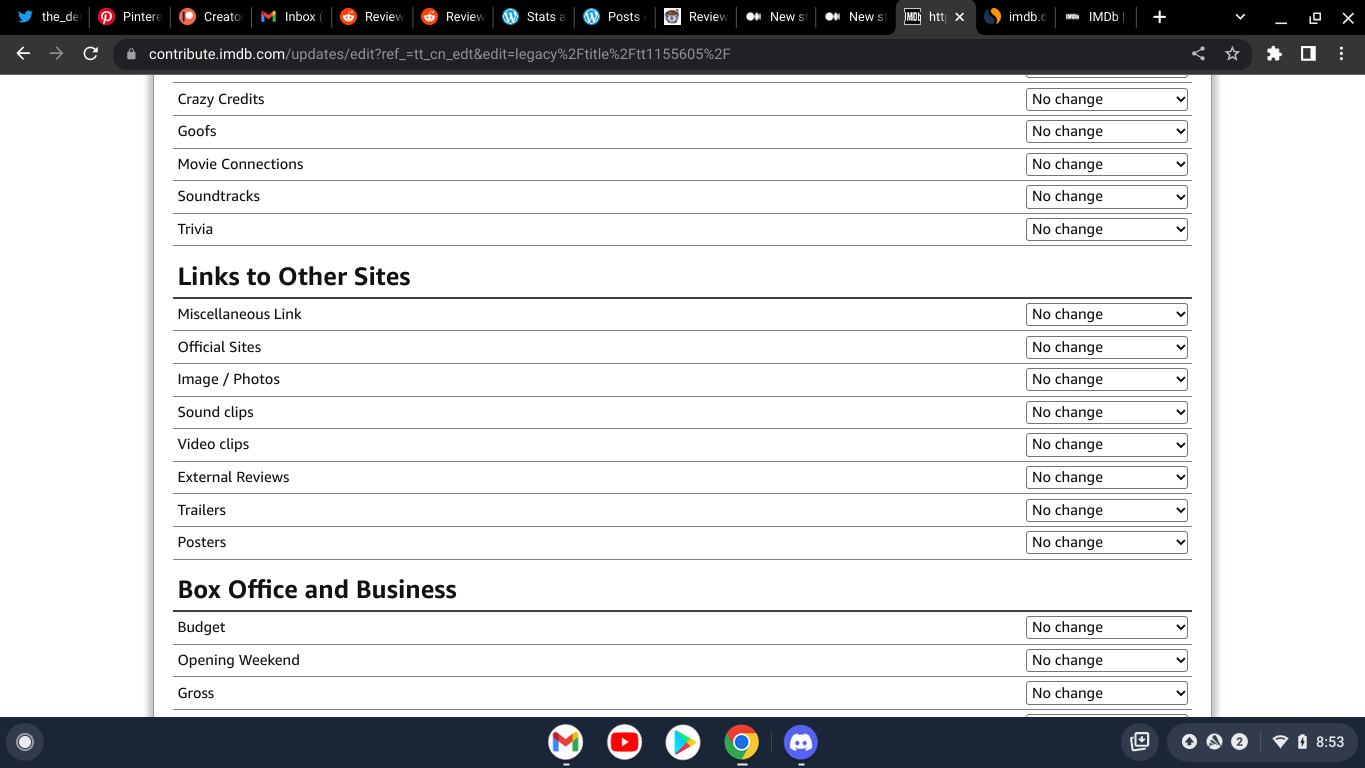
Step 4: If you’ve got a contributor account, you’ll see a page like the one below with a lot of categories. Go all the way down to “Links to Other Sites”. There you’ll see “External Reviews”. Click on the drop down in that section. You’ll want to switch it from “no change” to “add 1 item”.

Then confirm the changes.

Step 4: Then you’ll be taken to the that you can leave your review. Put the link in the URL spot. For the description use your pen name, or the name of your website. Then click “Check these updates”.

It will take you to another screen asking you to confirm the updates you’ve made. If you’re good to go, then submit them. On their end, there will be a quick overview process. I don’t know what that is exactly, but as long as you’re not being completely disingenuous, you’re in the clear.

It should put your review through fairly quickly. On average it never takes me more than an hour to see my review posted up.

After it’s been posted, you’ll see your critic review added in that section along with all the others. Sometimes, you might review a series that doesn’t have any critic reviews at all. You can be the first one, just like I am here in this image.

See? It really is that easy.

Hip Shot: Don’t know what to write about? Here’s a prompt for you. Find a series with no citric reviews. Watch that series and then write your own. Share it on IMDb like I did with my review of A Little Snow Fairy SugarYes, I know that was a completely shameless plug. No, I don’t care. My point still stands.

Following Trends: If you click on the search menu for IMDb, you can find “Most popular movies” and “Most popular TV shows”. You can also see the top 250 movies and top 250 television shows. If you’ve suffered writers block, you’ve probably seen at least one of these. Find a short series or a movie, watch it and write your review on it.

Many of you can benefit from writing reviews. Even if they aren’t your main form of content, don’t overlook them. A review can provide a tangentially tied experience for your readers.

More importantly, a review can bank upon your larger backlog of content and bring in new readers. Reviews provide entry level content and simple accessibility, we need to remember that.

A few key demographics can really benefit from this.

Gamers:

Plenty of games are actually tied loosely to anime or live action movies. Sometimes you can get both. You can diversify your content by writing reviews about those series. This is particularly true for horror and the RPG/MMORPG/ARPG genres. Brawlers, you guys are in the clear too.

RWBY, Halo, World of Warcraft, Resident Evil, Walking Dead, Final Fantasy, Dragon Ball Z, Inuyasha, Naruto and even Mortal Combat has a movie.

Take advantage of these titles. There’s even more too, like Prince of Persia: The Sands of Time. It released just this year. I promise you there’s plenty more where that came from.

Use them…

Newbies in Celebrities/Politics/Sports/Hobbies:

When we love a hobby, we are likely to watch content based around that hobby. This is a no brainier. There are movies, shows and documentaries based around these things. Use them to gain early attention. If you’re new and unknown, grasp onto this kind of media with a vengeance.

This is a key aspect of diversifying your content. When you’re new this can be difficult.

Nero-divergent/Otherwise Able:

If you are a lifestyle blogger with a disability, see if there might be media based on that. You can review that series and provide a personal perspective as well. There’s something to be said about providing insight to these important topics.

Final Thoughts:

At first, blogging can be hard. Getting your name out there requires thinking outside of the box. Many people don’t realize how easy it is to get onto websites such as IMDb. They see the word “critic” and quickly become intimidated. It’s okay though, you don’t have to be.

Use all of your tools to get your name out there. Use every advantage. This is a free one, and it’s easy to do. Go ahead, give it a try and let passive views slowly flow in over time. In the meantime, keep putting your best foot forward. Work to get better and continue your endeavors as a content creator. In time, you will succeed.

That’s it for today. Was I of any help to you? If so, drop me a follow. You’ll be getting more tips and tricks for bloggers soon enough.

This has been Kernook of The Demented Ferrets, where stupidity is at its finest and level grinds are par for the course. I’ll see you next time!

The First Thing Bloggers Need to Know – Readability

You know, it’s funny. When I graduated from high school back in 2007, I knew one thing about my life and only one thing. I was never going to enter a university or higher education. It just wasn’t for me. Then again, it seemed to me that so little in the world could be “for me”.

I was adrift with what to do in my life. I ran through the gambit of jobs that you get right out of high school. Corner store clerk, Yep. I’ve been there. Hamburger flipper, yep, I’ve done that too. I was also the poor unfortunate soul that management crams behind a service desk during peek holiday seasons… the dreaded “temp” worker.

From babysitting to mowing lawns, I drifted through many jobs trying to find my place in this vast world. Eventually though, I found my calling; freelancing. Now, I’m not your typical “gig worker” in the sense that I only write blogs or that I only work for writing mills.

I don’t make my income entirely based on that, and most bloggers don’t. It really is nice when someone can have a mastery and build that following to only be a bloggerI’m going to tell you a little secrete of the trade, something a lot of people don’t want you to know.

We’re jacks of all trades, but we’re rarely masters at any of them. Success is easy to brag about, once you’ve got the clout. What about if you don’t though?

I’m not writing this to get your attention, I’m writing this because I’m going to tell you the truth. You’ll follow me of your own volition, or you won’t. If not, that’s fine, but I promise you this; I’m going to give you good advice.

How many times have you read about finding your niche audience? What about defining keywords? Oh, here’s a good one. How many times do you see bloggers talking about the big traumatizing “algorithm” we all battle on a daily basis?

Now I have real hard hitting question for you. Do you, as an aspiring blogger, know what “REI” stands for? What about just the word readability? Do you know what that means?

This is your first lesson. “REI” stands for Reading Ease Ideal.

To be simple, it is just a tool we use. Reading comprehension is a requirement of a good blog. Reading ease tools measure reading comprehension. It tells you how easy your written word is to understand. That’s all “readability” actually means.

Understanding the reading level of your target audience matters. Your blog will be useless if your target demographic can’t comprehend it. You need to master this before you try to master keywords and algorithms.

If you want to get an edge, begin at the heart and soul of the craft. Master your ability to understand your own writing. There’s all kinds of reading ease measurements out there. You need to learn about them.

You need to have all the tools in your tool belt. You’ll gain an edge over other bloggers. Many don’t understand this concept. If you understand what REI means, and how it needs to be used, you’re going to have a better shot against the competition.

Getting your foot into the big media doors isn’t always easy. If you write effectively from the onset, you’ve got a much better chance. That’s the reality. Major publications have standards for reading comprehension.

For example, Time Magazine has a median reading level of “grade 7”. This means the average 13 year old can read the magazine and understand the content in it. Reader digest aims for a baseline of around 15 years old.

That’s not to say the content will appeal to those ages, mind you. The basic reading level of your blog and your target audience are not the same things. However, they are symbiotically tied together.

Therefore, I repeat: Reading Ease Ideal.

Cram those three words into your heads. Old veterans in blogging can roughly determine these things on their own. We can do this by sight alone. That takes practice. If you don’t have the skill, learn the skill.

Step 1: Before you start digging into keywords and algorithms, make sure you have a good word processor.

Step 2: Figure out what metric for reading ease that processor uses.

Step 3: Then you decide what sort of content you want to make. Find out the target ages and the reading level of that group. Look at what the reading level is for major publications in your niche. You can google this, for a lot of big industries.

Step 4: Make sure ALL of your posts are within the target metrics.

If you are writing for a relaxed reader, you’d better not be posting university level reading material on your blog. If you are writing to be understood by the average reader, keep that in mind. You should not go above the reading level of the average young teenager. Unless you are writing Reader’s Digest level material, don’t toss around “grade 9” blog posts.

The lesson here: write for your readers.

That is the most important detail. Do not deviate from that mindset as a newbie. If you do, your posts feel inconsistent and sloppy. During your editing phase, edit to suit your target demographic directly. How educated is that group? Does your post meet the reading ease required for that group?

Figure that out before you post.

Once you start doing this, you’ll be a better blogger. I say this because it is resoundingly true. Every blogger making the big bucks, knows this is true. Middling bloggers like myself, wishing to compete with the pros, learns this is true.

It will help to improve your SEO rankings. You will have a much easier time defining your keywords later on. If you found this helpful, follow me here on Medium. You’ll be getting more tips and tricks like this soon enough.

I’ll leave you with my scores for this blog post. That way you’ll know I’m not feeding you a bunch of nonsense:

Readability Consensus
Based on (7) readability formulas, we have scored your text:
Grade Level: 5
Reading Level: easy to read.
Reader’s Age: 8–9 yrs. old (Fourth and Fifth graders)

After Post:

See what I mean? A child could read this post if they wanted. It’s not aimed at them, but that doesn’t rightly matter. I just wrote it and tossed it. Sure there may be spelling errors, I’m not going to edit this stupid thing. It isn’t because I don’t care. I just wanted to prove a point, reading ease matters. If you can do it by sight alone, you’re a step ahead of the game.

Follow me for more content, you’ll be glad you did.